

The first breathable air of the season has brought a reprieve to Paris. From the terraces, the clamour of people drinking and talking reverberates through the streets. In certain squares, on summer afternoons or in the early hours of the weekend, teenagers gather in small clusters to rehearse choreographies of their own. In front of the Comédie-Française, on some evenings, a crowd assembles to dance to live music, encircled by spectators and passers-by. Nowhere else I have lived have I seen people love to dance as much as they do in this city.
Dance is one of life’s simplest pleasures. What could feel more natural than letting the body move freely to music, or snapping your fingers to the beat? For me, it is the easiest way to lift a mood: the music begins, the body moves with it, and the day already feels brighter.
I also love to watch other people dance. When I watch classical ballet, I am always struck by how weightless the dancers appear, by the way they sustain a line en pointe. The way they cut through the air gives me the sensation of an unreal world, full of marvels and free of care or disquiet, an illusion I occasionally welcome.
Contemporary dance remains one of my great passions. I am mesmerised by the way complex choreographies come into being: the dancers follow a set of rules I can hardly decipher, if I can decipher them at all, and yet those rules bind the whole into a unified, dazzlingly harmonious composition capable of expressing so many emotions. Recently, at the Palais Garnier, I saw Vibrations, an evening in which three choreographers were invited to present a piece. It opened with Dreams This Way, Micaela Taylor’s debut for the Paris Opera, in which elastic bodies moved, bent, contorted and interlocked with impeccable precision, to music by Tru. Mats Ek’s Solo for Two conveyed the density of love within a couple and led us through a range of emotional states, from desire and tenderness to anger and separation, set to a haunting score by Arvo Pärt. The evening closed with Crystal Pite’s The Seasons’ Canon, first created for the company in 2016 and set to Max Richter’s electrified recomposition of Vivaldi’s Four Seasons: a living organism, a current of bodies moving in collective waves, a reminder that the individual exists only through connection to others, including nature. Three ways of making the body vibrate.
Since then, I have been thinking about dance in painting and drawing, and about the difficulty, above all, of capturing movement on a flat surface, of conveying the jubilant nature of dance to a viewer who stands before the canvas and hears no music.
Poussin, A Dance to the Music of Time (1634–36)
The first painting that comes to mind is Nicolas Poussin’s A Dance to the Music of Time, now in the Wallace Collection and perhaps the most important image of dance in his oeuvre. It is also one of my most beloved works.
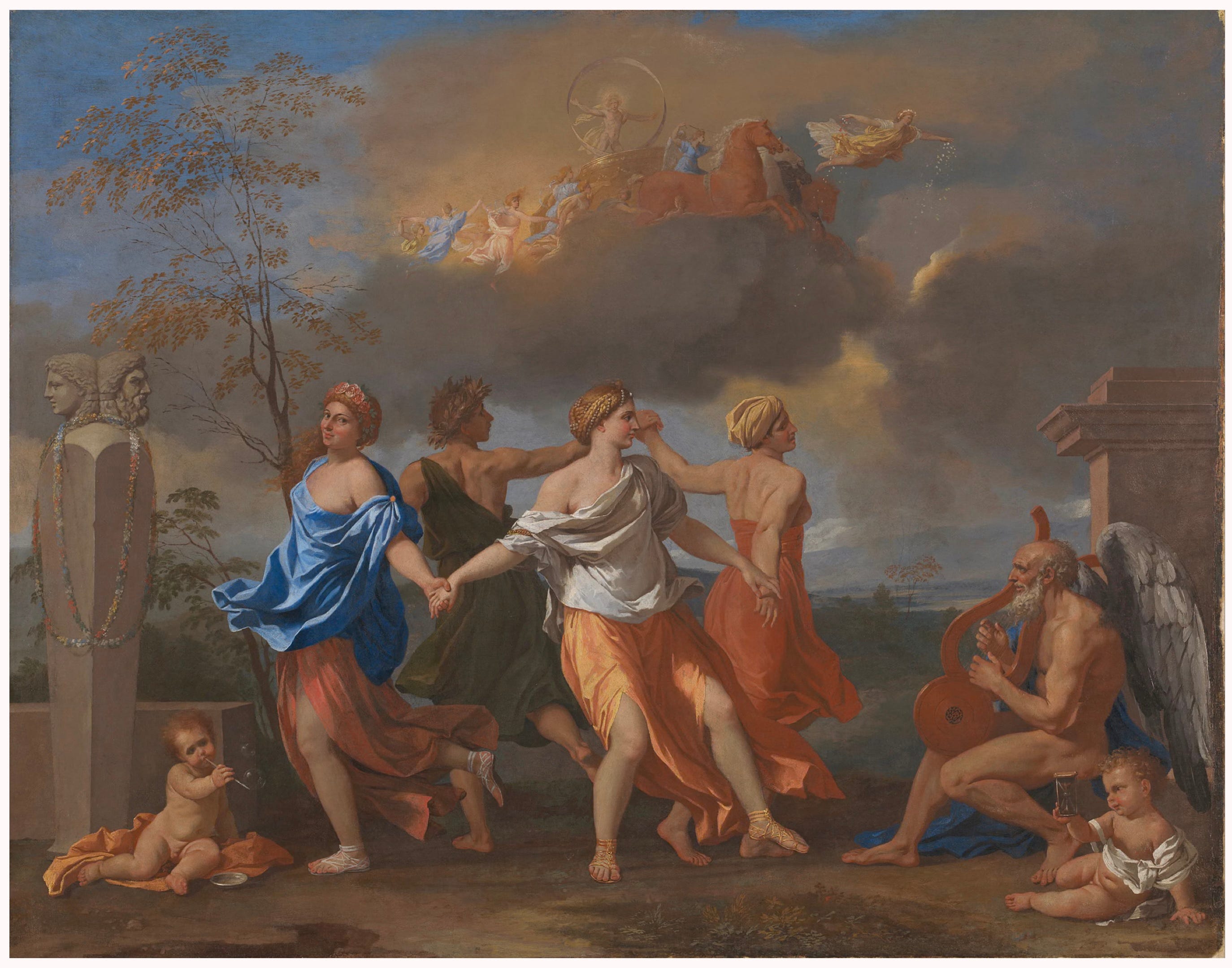
Four dancers hold hands in a closed circle, fated to spin for ever. The painting is an allegory, of course, and several readings are possible. Some take the figures to represent the four seasons; others see in them four stages of life — poverty, labour, riches and luxury — turning in a cycle that returns, through excess, to its point of departure. My own view is that it is an allegory of the human condition, presenting the stages of a life as it passes from Poverty to Labour, then to Riches, then to Pleasure, and back again to Poverty. This circle has neither beginning nor end.
Look closely at the upper part of the composition: Aurora scatters flowers as she leads the chariot of Apollo across the sky, the dancing Hours following behind. One Poussin scholar has described the work as a clock in motion, in which we may admire the expression of celestial time, of time unfolding in the heavens. Below, in the world of mortals, the winged figure of Time sits playing the lyre, and his music seems to set the rhythm for the four figures who revolve hand in hand before him. Two putti flank the scene, one tipping an hourglass, the other blowing soap bubbles. The painting becomes a complex memento mori, a reminder of the brevity of life and of the fragile beauty of happiness, a dance of pleasure that cannot last.
Poussin showed a sustained preoccupation with how to animate the still image. He explored the effects of light and the volumetric modelling of bodies so that they seem to move across the flat surface. In A Dance to the Music of Time, his formal solution was partly adapted from the antique bas-relief known as the Borghese Dancers.
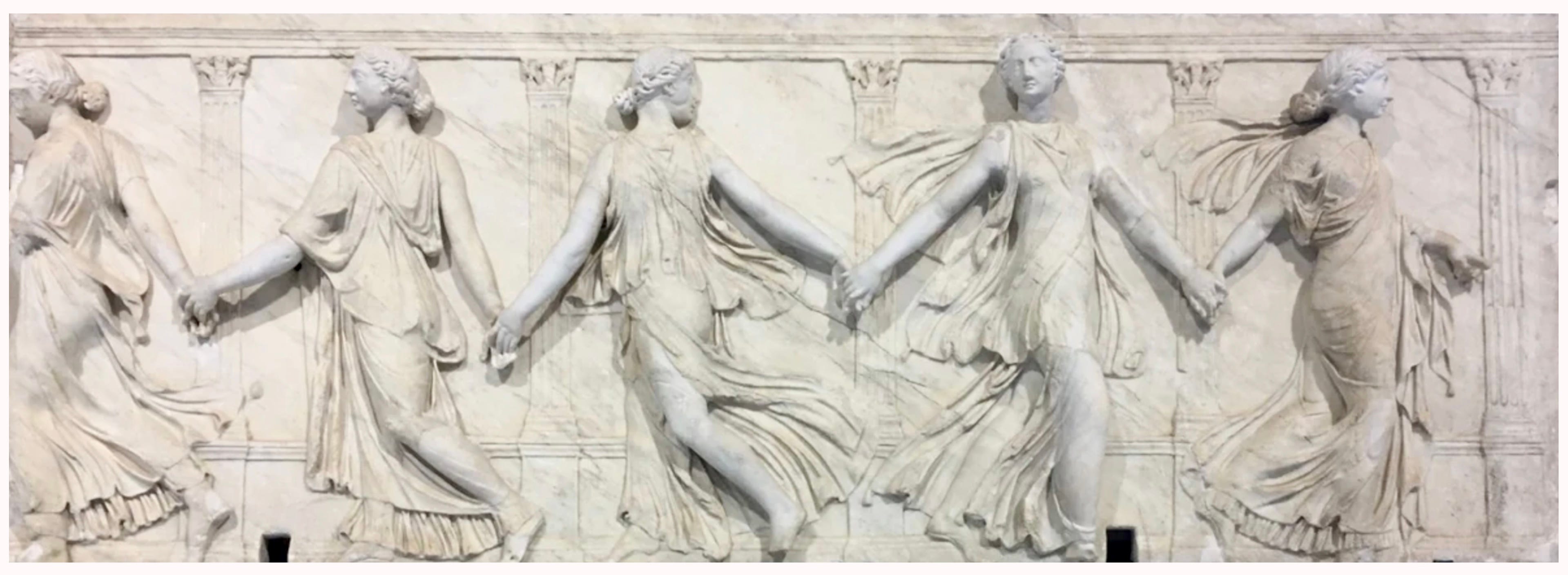
This Roman sculpted frieze presents figures joined in motion, as if inhabiting an imagined world of ritual, pleasure and harmony. Although Poussin knew many celebrated antiquities that depicted dancers, this relief proved to be his favourite point of departure for various compositions.
Effortlessly translating sculpture into painting, Poussin mastered the ability to move across media. It is little wonder that he remained a touchstone for generations of artists, from David and Cézanne to Picasso and Bacon. Among the many enduring facets of his legacy are these classical compositions, in which antiquity serves both as subject matter and as a means of testing and asserting the possibilities of painting.
Matisse, Dance (II) (1910)
While Poussin’s circle is a clock that ceaselessly reminds us of the passage of time, Matisse creates a hymn to life, to joy, to physical abandon. Commissioned, together with its pendant Music, by the Russian collector Sergei Shchukin for the staircase of his Moscow mansion, Dance reduces an entire bacchanal to three colours: a royal-blue sky, an emerald hill, and five pinkish-red bodies barely contained within the canvas. There is no evident perspective, no clear sense of where this dance takes place. Emotion is produced through composition, line and tone. The five figures perform their famous round, their faces barely traced. What strikes us at once is the rhythm, the leap and the stamp, the near-fall of bodies whose joined hands reach out to close the circle.
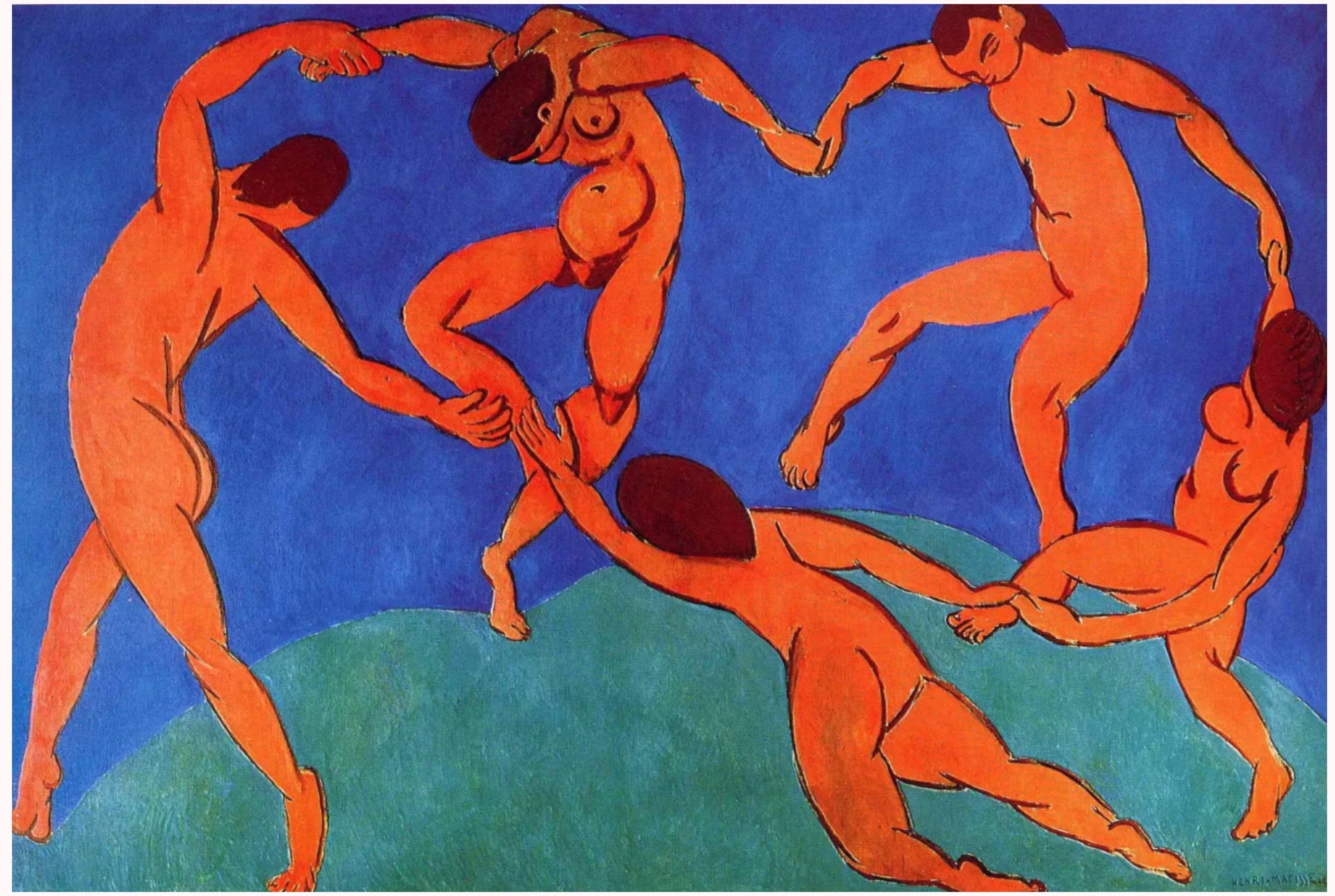
The pigments, as one critic reportedly observed while watching Matisse work, came straight from the tube. The daring nudes and raw hues scandalised the 1910 Salon d’Automne, where viewers perceived them as ferocious, even brutal. It was not the first time an artwork had proved harder to comprehend than to condemn. The difficulty came, in part, from Matisse’s radical simplification of form: the elimination of modelling, descriptive detail and conventional spatial depth. A year earlier, he had argued that photography had freed painting from the need to imitate nature, allowing pictorial form, colour and space to be reorganised as means of expressing sensation. Matisse’s paintings of this period show his move towards decorative structure and flattened space, and reveal how he negotiated between the inherited tradition of painting and modernist autonomy.
One might wonder: why the circle? The scholar Pascal Rousseau offers an answer. Matisse often went to the Moulin de la Galette, where he watched the farandole at the close of Sunday afternoons: dancers running hand in hand across the hall, gathering up the strays, a ring that opens to bring in those who have wandered off. This is the theme of the painting: community, communion, gaiety. And the connections extend further still, through the Catalan sardana and the rougher dances of the fishermen he saw at Collioure; through Isadora Duncan, whose return to nature and to Greece he admired; and through the red-figure vases of the fifth and fourth centuries BCE, which is partly why the bodies of the second version burn red where the first remained flesh-pink. Drawing on ancient images and sources, Matisse rethinks dance as both a pictorial subject and a concentration of sensation.
Renoir, The Three Dances (1882–83)
Renoir gives dance, as lived by the modern couple, the most exalted frame imaginable. Dance in the Country, Dance in the City and Dance at Bougival, painted in 1882–83, just after Luncheon of the Boating Party, adopt the full-length format of the history portrait, once reserved for sovereigns and prelates. The verticality serves a purpose. Renoir draws close to his figures, compressing or suppressing the surrounding environment so that the dancing pair occupies almost the entire pictorial field. This tendency is characteristic of his work more broadly: proximity takes precedence over setting.
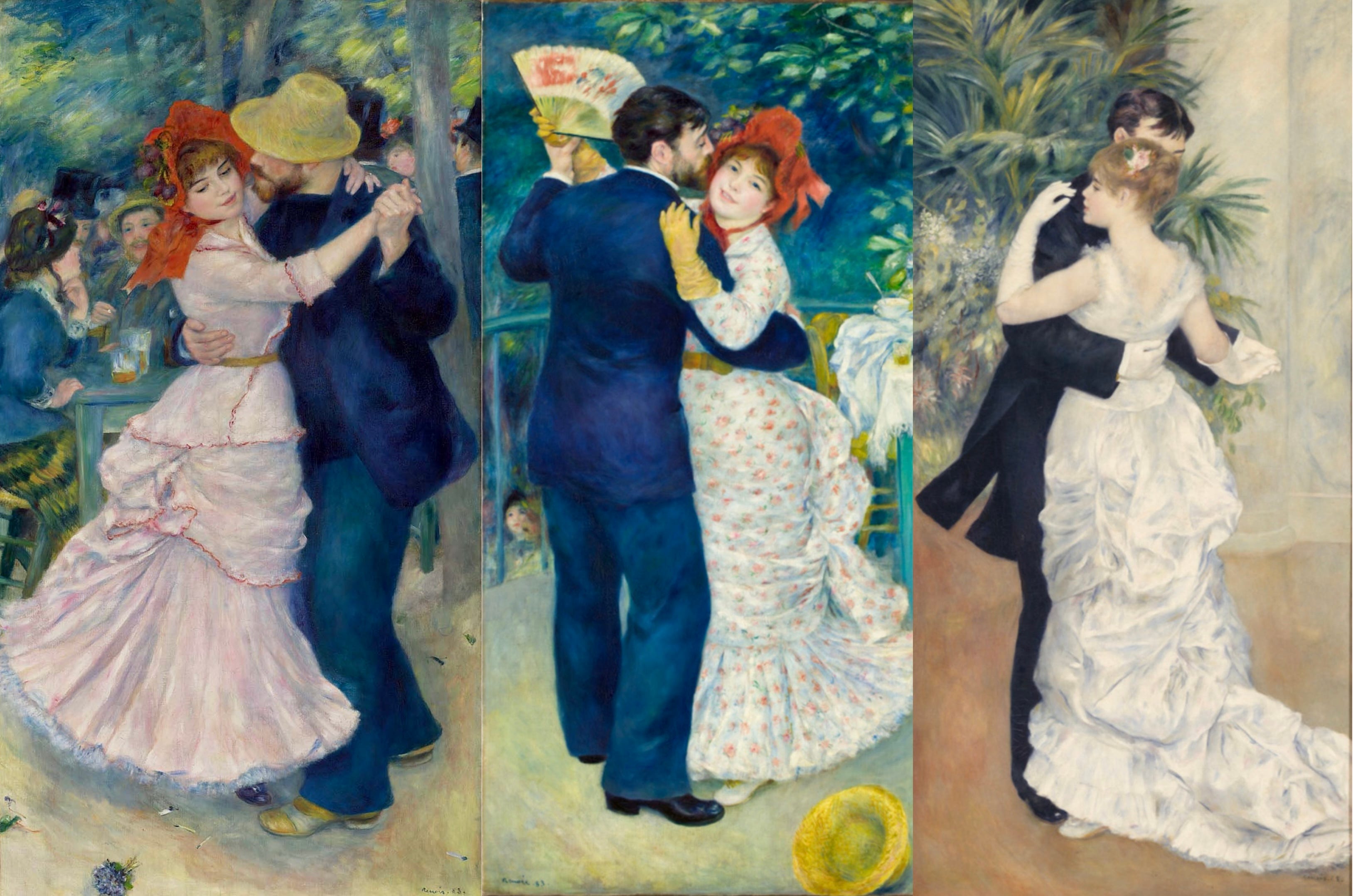
Dance in the City stages an evening of bourgeois refinement. Dance in the Country is more cheerful and expansive. The dancers seem to have risen directly from the table; a hat lies abandoned in the foreground; Aline Charigot, Renoir’s companion and model, turns away from her partner and looks directly towards the painter.
The masterpiece of the three is Dance at Bougival, one of the most beautiful paintings in Impressionism as a whole. The swirl of the skirt, the ribbons still seemingly caught in motion, and the softly blurred background produce the sensation that the spectator, too, has entered the turn. Glasses on a nearby table suggest a slight intoxication. The dancers hold one another closely, his hand at her hip, hers upon his shoulder, ungloved. Physical contact is immediate, unmediated. Behind them, café-goers gather beneath straw hats, but the couple have turned their backs on everything; nothing exists beyond the pleasure of the dance.
Paul Perrin, one of the curators of the exhibition, still on view at the Musée d’Orsay before it travels to the National Gallery in London, argues that for Renoir this embracing, perfectly synchronised pair embodied a kind of philosophy: an ideal of love and social harmony conveyed through a subject as simple, and as profound, as two people dancing.
Lynette Yiadom-Boakye, The Dancers (2015–22)
Lynette Yiadom-Boakye paints fictional people, subjects assembled from memory and from her own imagination.
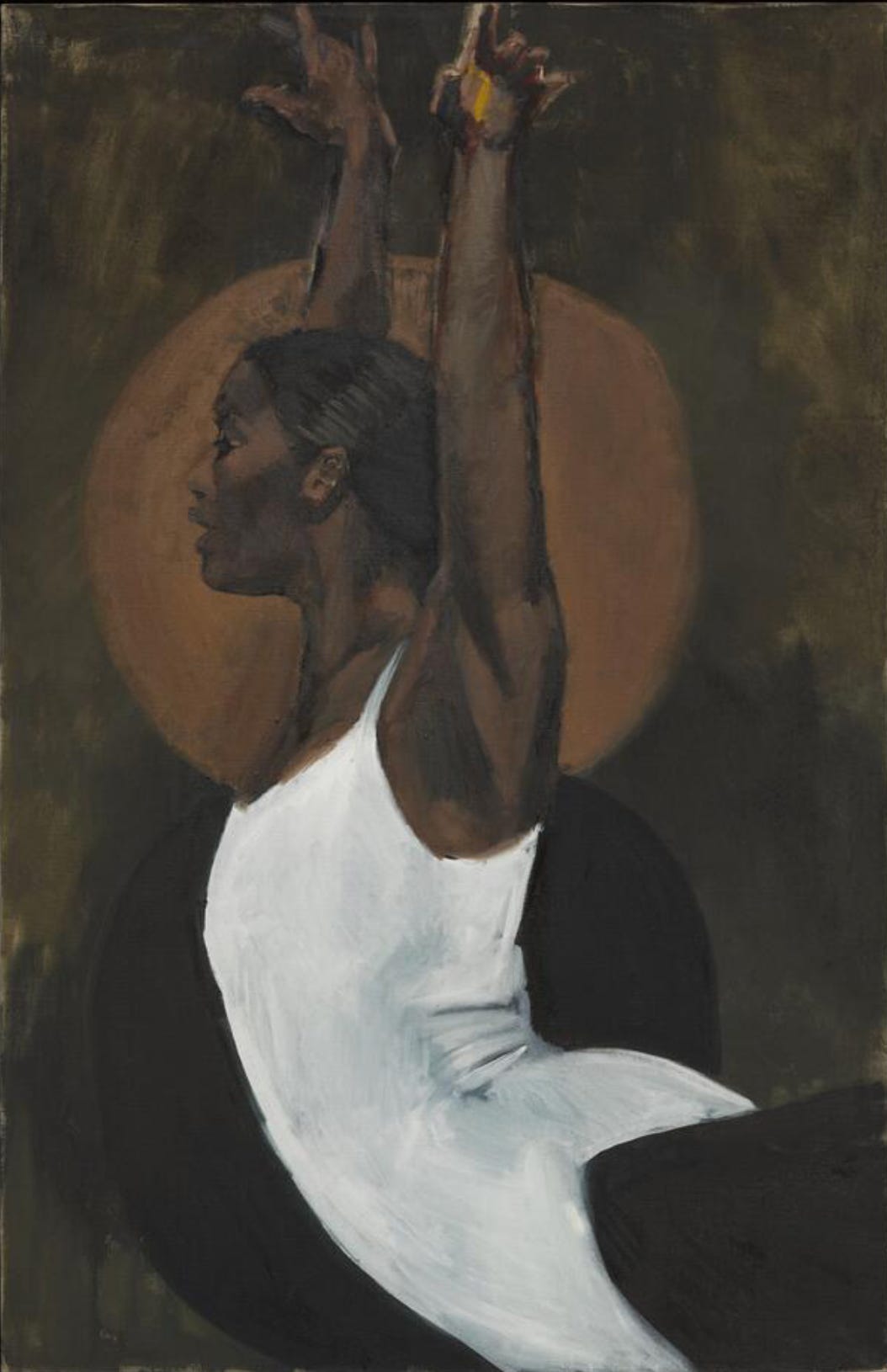
In Light of the Lit Wick (2017), a dancer in a white leotard stretches her hands upwards against a dark-green background, her gaze fixed on a point just outside our field of vision, frozen in the middle of an arabesque. She is concentrating, holding the pose as best she can. Yiadom-Boakye juxtaposes the muscular tension with the ballerina’s serene expression, emphasising it through fluid strokes of oil paint.
The pose recalls the balanced elegance we remember from Degas’s ballerinas, but the comparison only highlights the difference. Where Degas observed real dancers at the Palais Garnier and subjected them to prolonged, posed scrutiny, Yiadom-Boakye’s are invented, and at their ease.
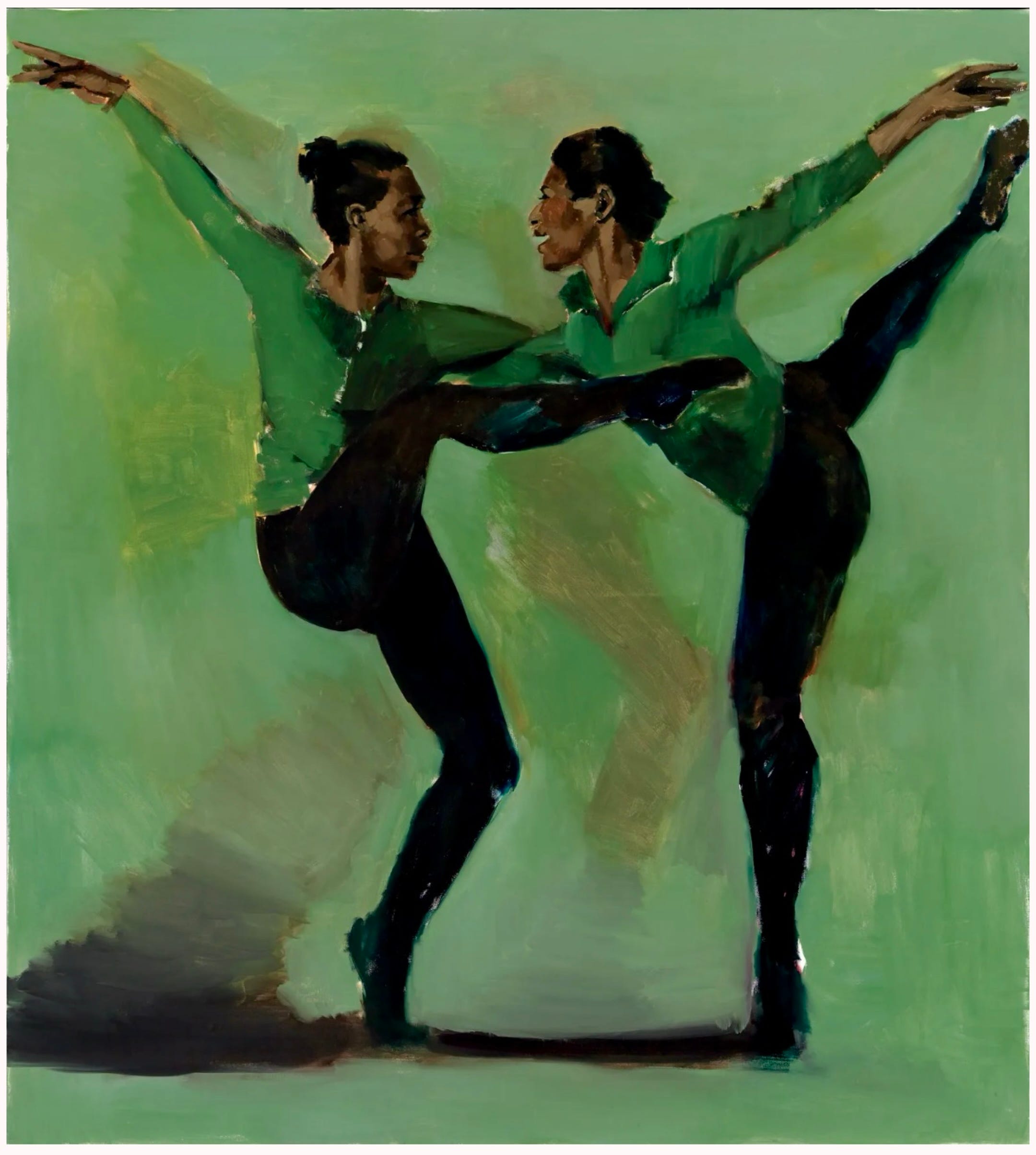
A more telling canvas is To Douse the Devil for a Ducat (2015), in which two dancers, their faces turned towards each other, are caught in a dynamic rhythm. Both wear green tops and dark, nearly black leggings, set against a luminous mint-green background. The brushstrokes are visible, and patches of warm brown and blue define muscle and movement with fluidity. Yiadom-Boakye has said that she wants to make people intelligible through painting, and to represent Black subjects not as emblems of suffering, but simply as they might be in the world.
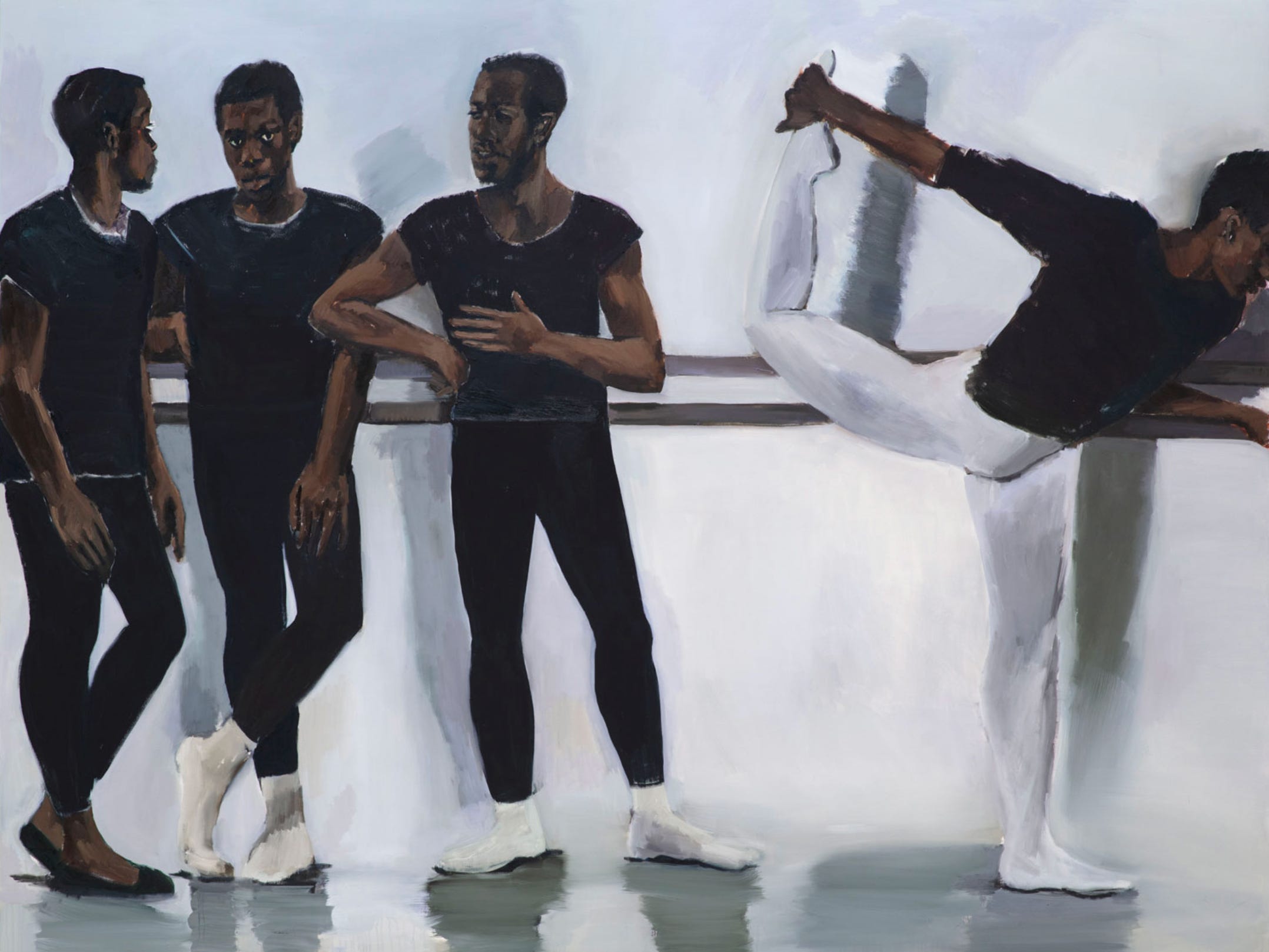
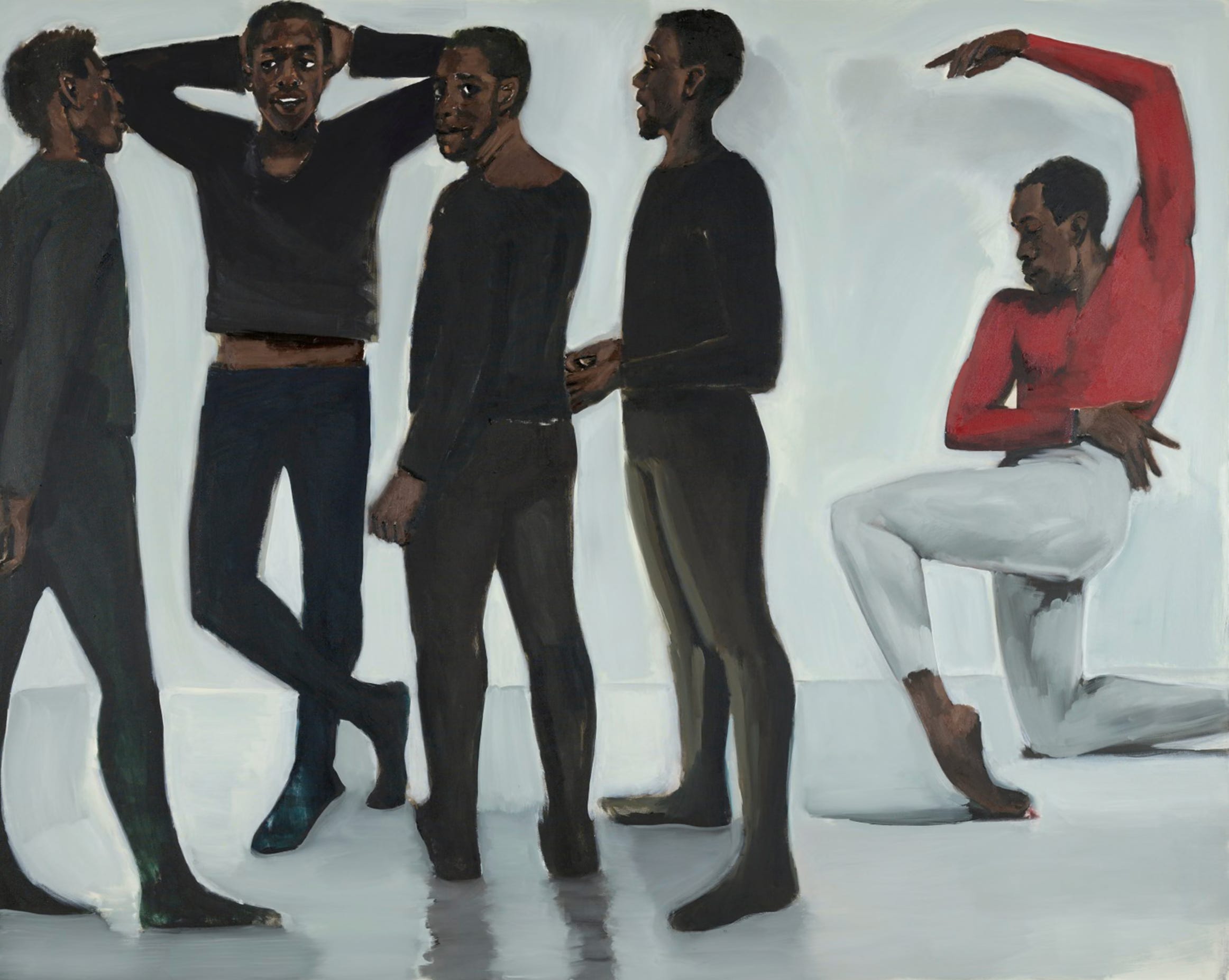
In A Concentration (2018), as in A Transformation (2022), she turns her attention to male ballet dancers, caught in moments of respite or in the disciplined torque of a stretch. Historically, Black dancers have often been marginalised, when not excluded outright, from classical ballet. Yiadom-Boakye’s work helps to fill this gap in representation, imagining a counter-archive in which Black male grace, effort and self-possession occupy the centre of the pictorial field.
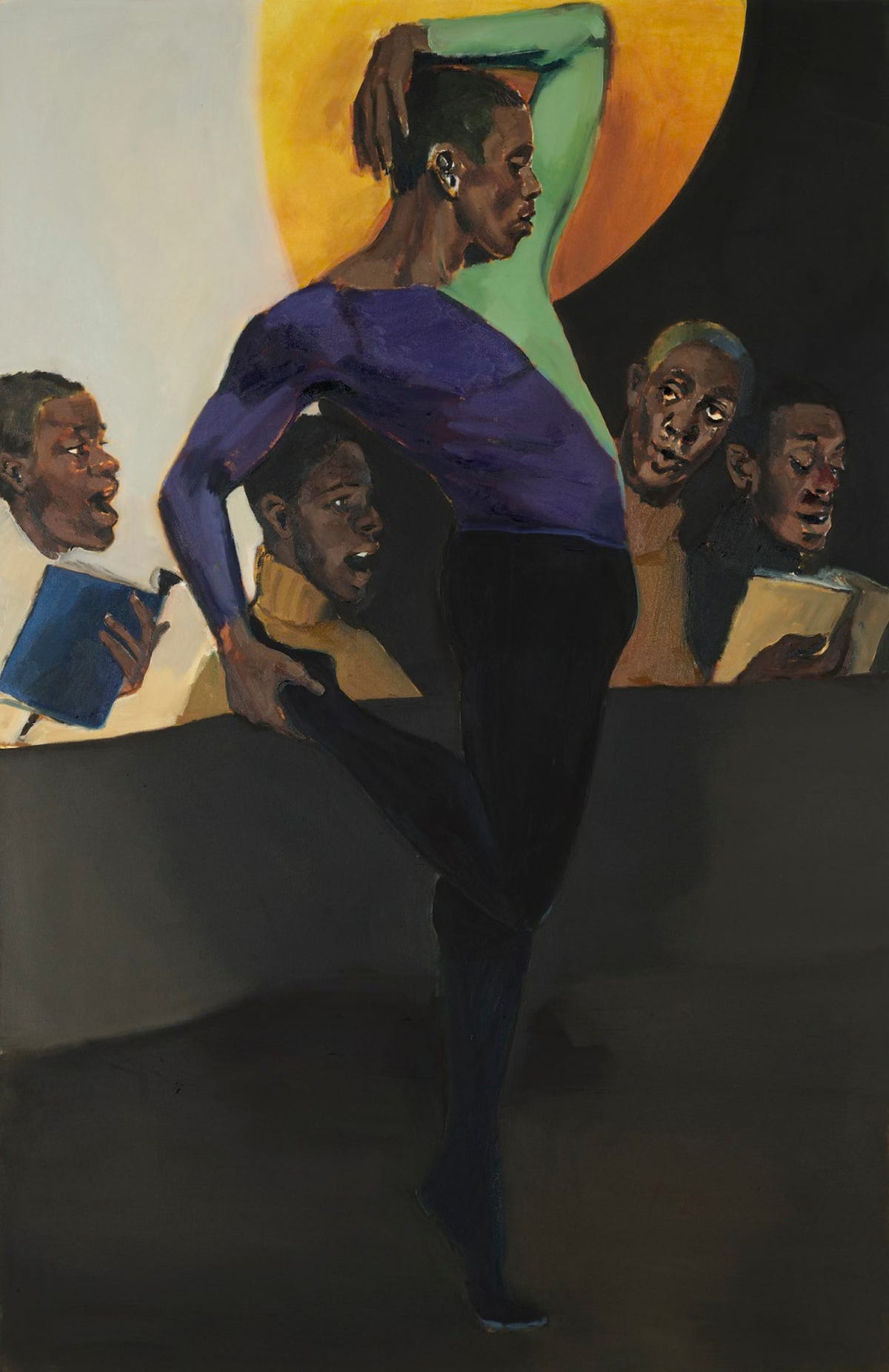
In Dangle the Keys to a Kingdom (2022), a poised dancer stands in a taut, elegant contrapposto, one leg crossed and lifted, one arm bent overhead. Behind the central figure, four singers form a chorus, their open mouths and angled gazes framing the dancer’s performance. Here, too, Yiadom-Boakye works in broad brushstrokes, drawing out rich shadows and giving the figures emotional intensity and physical presence.
After the circling groups of Poussin and Matisse, and the interlinked couples of Renoir, Yiadom-Boakye returns to the Black figure, alone or in company, and always in the foreground. These portraits of dancers capture something of their inner lives: a dancer caught between one instant and the next. Whether engrossed in concentration or immersed in the flow of music, her subjects are rendered, through oil on canvas and a deliberately restrained palette, with profound interiority.
The artist once said that she paints what she cannot write and writes what she cannot paint. In a sense, her dancers appear as figures glimpsed mid-gesture, in a story whose beginning and end she withholds.
Faith Ringgold, Dancing at the Louvre (1991)
Faith Ringgold’s Dancing at the Louvre, the first of the twelve story quilts in her series The French Collection, is entirely about breaking the rules, and about how marvellous it can feel to do so. Her narrator, Willa Marie Simone, is a young Black woman who has moved to Paris at the beginning of the twentieth century. There she meets artists, writers and musicians, among them James Baldwin, Gertrude Stein and Josephine Baker. One day, Willa Marie takes her three little girls to the Louvre, ostensibly to see the Mona Lisa and other Western masterpieces. The children, spinning through the galleries, become the true spectacle.
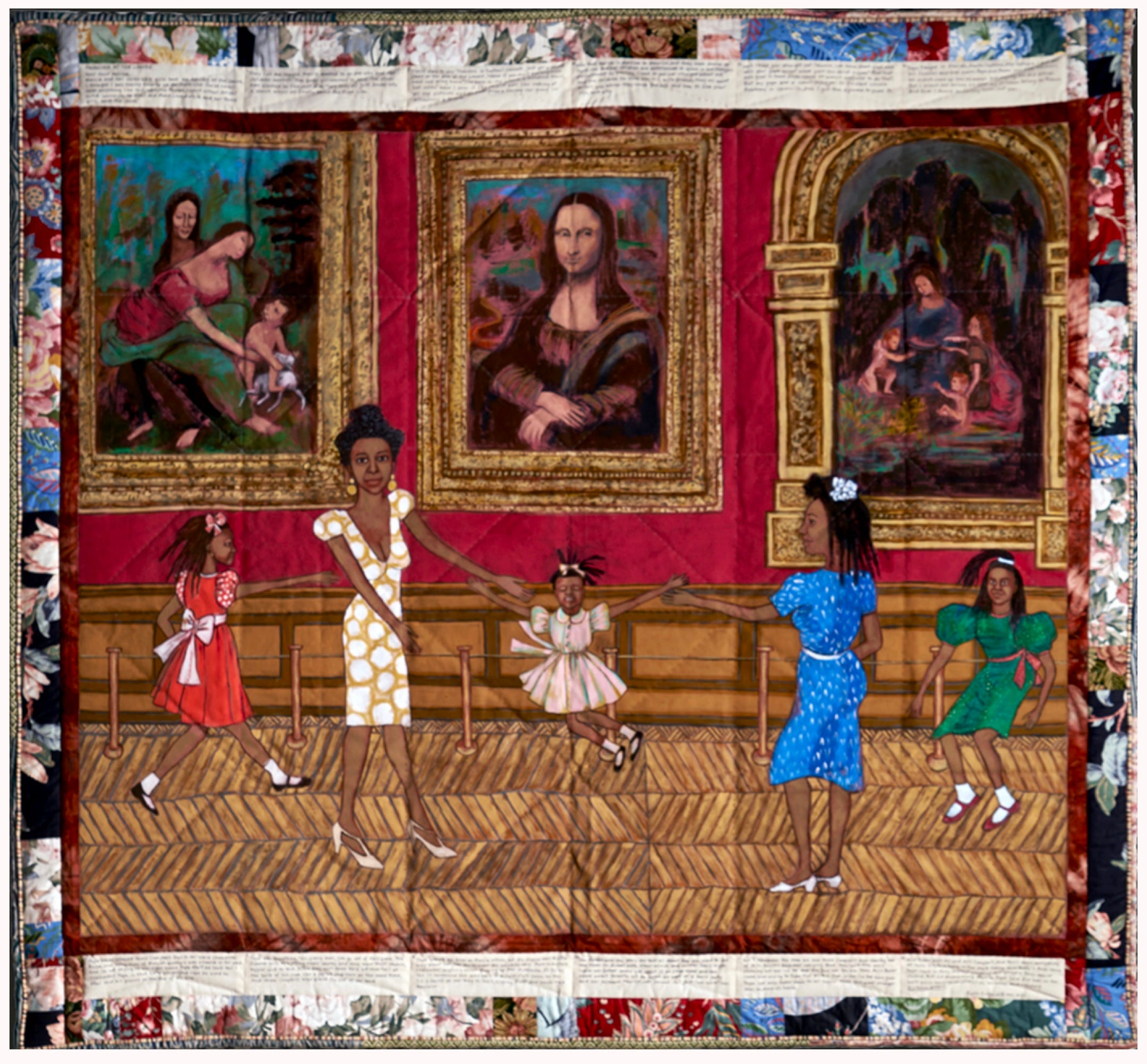
Ringgold combines figurative painting with African American quilting and handwritten text that unfurls along the border, so that the work is at once image and story. After so many painted circles of dancers, here at last is dance unleashed within a room and within a narrative, irreverent and joyous, reclaiming the museum, the institution of European art, as a place in which to move freely.
This is dance as a deliberate act of reappropriation. Drawing on her own long struggle for recognition in an art world governed by European traditions and male-centred canons, Ringgold uses the story quilt to rewrite the past, weaving modern art, African American culture and autobiography into a single work: a postmodern gesture, opposed to modernism’s dream of pure autonomy and universal meaning. The technique speaks for itself. She paints the central scene in acrylic, surrounds it with a border of pieced and tie-dyed fabric, and assembles the layers through the traditional method of quilting, which official art history had long classified as craft rather than art. Dancing at the Louvre shows us how this story, and these so-called minor traditions, belong within the canon.
Five artists, each of whom found a way to make us feel the unheard music. Poussin turned an ancient bas-relief into a wheel of destiny; Matisse reduced an entire bacchanal to three colours and five outstretched bodies; Renoir raised anonymous couples into the format of history painting; Yiadom-Boakye painted dancers holding their poses in concentration or performing with extraordinary grace; Ringgold set her dancers laughing through the Louvre. Movement on a flat surface — the problem that sent me searching — has as many solutions as there are painters willing to try, and each solution is also a way of thinking about time, community, love, and who is permitted to enter the ring. There is a joy in standing still before a canvas where the dance never stops.
As always, thank you for reading—
A.
A few books I have enjoyed recently:
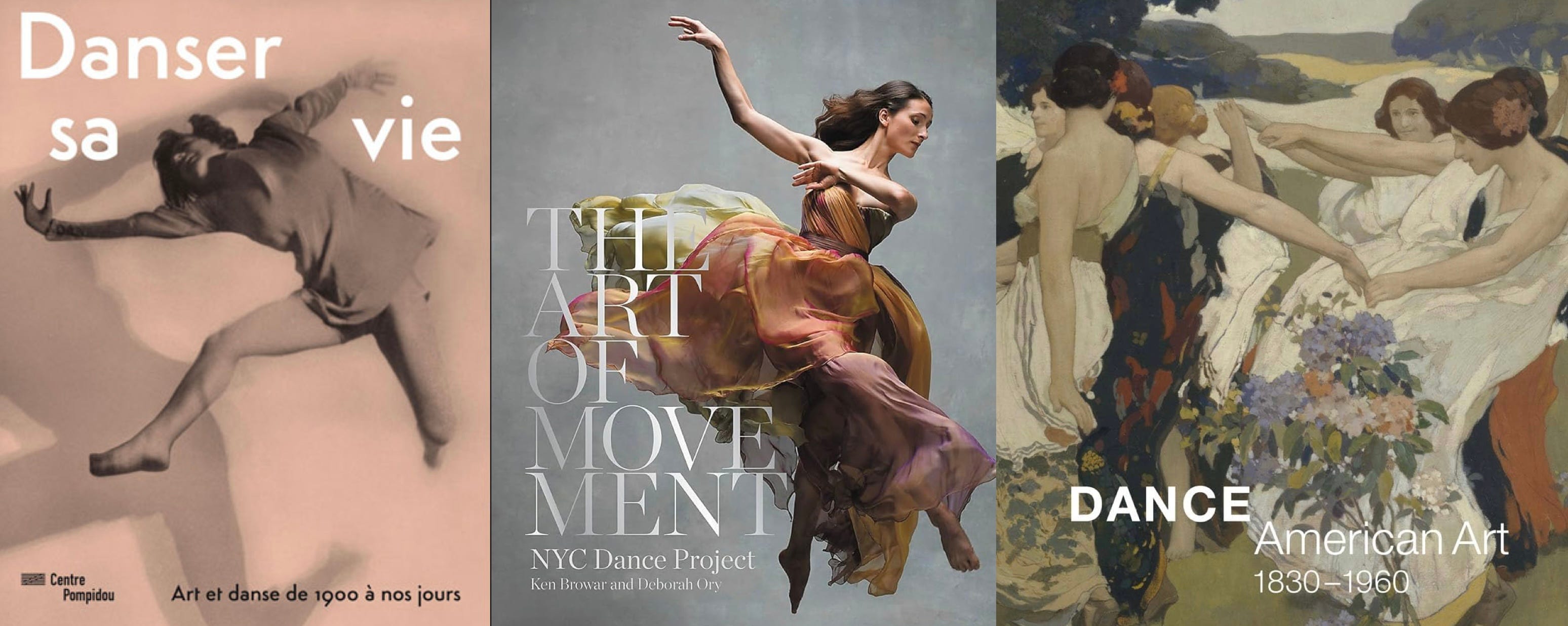
I enjoyed the historical range. I was especially interested in the inclusion of Lynette Yiadom-Boakye, whose work seems to carry the conversation into the present.
Thank you! Your post gave me pleasure, I haven’t seen several paintings before.