

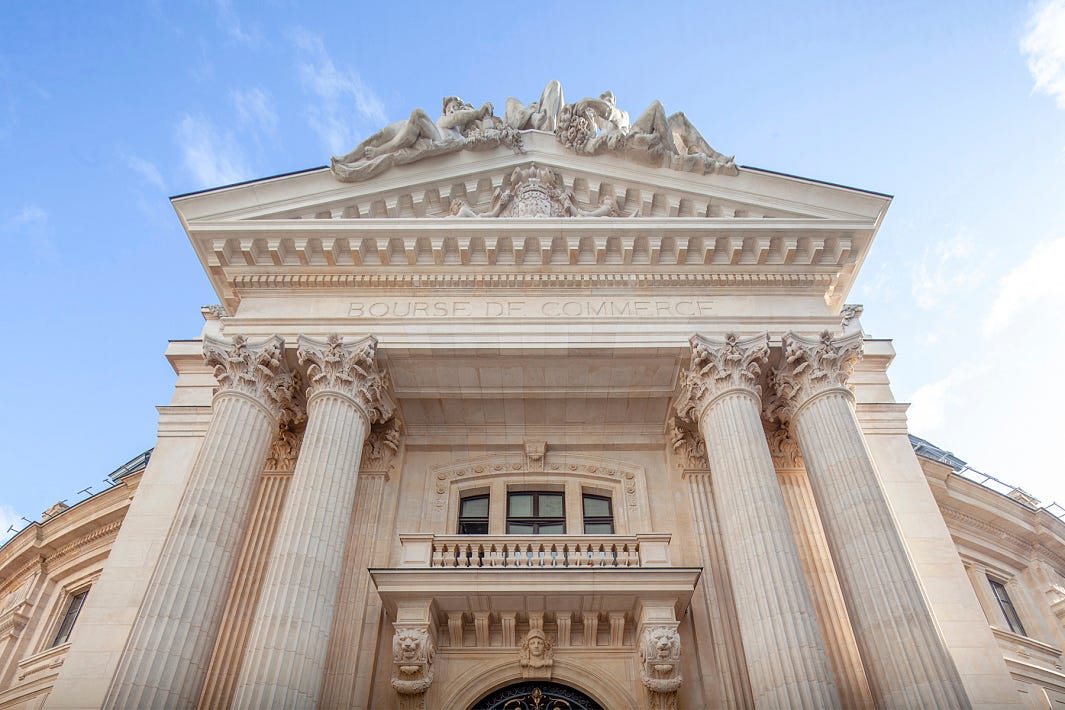
In the years since I moved to Paris, I have walked past it countless times. I have visited its art collection, returned for its temporary exhibitions, and met friends for coffee at the café across the way. Not long ago, I was inside the Rotunda, absorbed in Pierre Huyghe’s Camata (2024), a video projected on a large screen. It’s part of an ongoing series, edited in real time by artificial intelligence, in which robots investigate and perform funeral rites while the human species is buried by machines. Huyghe explores our relationship to space, time, and memory, centring on human bones unearthed in Chile’s Atacama Desert. Perhaps something in that video prompted me to think about obdurate materials: concrete, stone, brick. And sand.
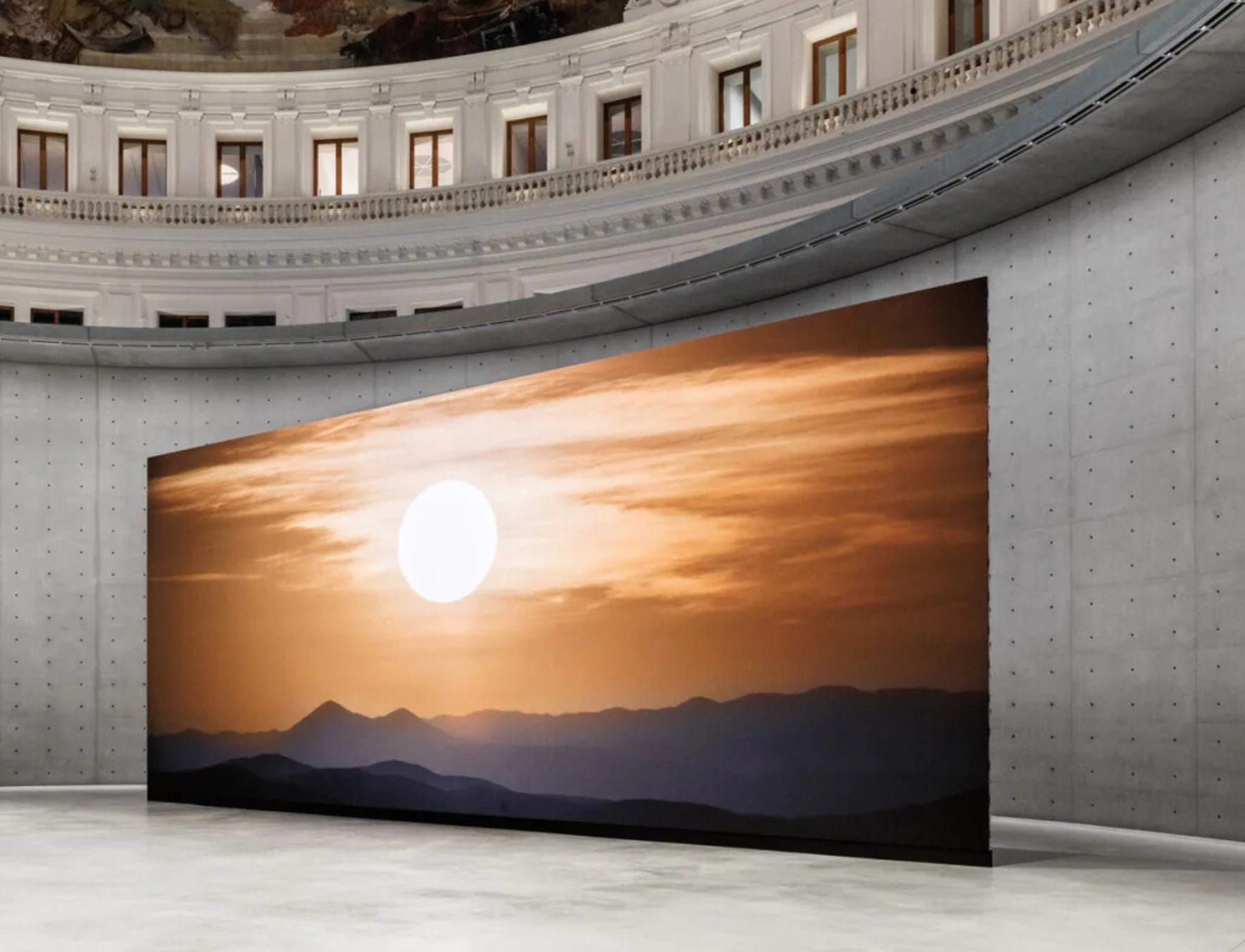
Afternoon light was filtering through the upper windows and the distant dome, casting shadows across the ring-shaped floor from high above. The room felt improbably exposed, and strangely beautiful for it. As it happened, there I was, thinking, of all things, about architecture. What, exactly, is architecture?
It is not a question architects often ask, just as artists rarely concern themselves with defining art while they make it. Surrounded by both, I found the question returning again and again.
It is, it turns out, a hall of mirrors.
Architecture in History
History books tell us that architecture dates back to around 3000 BCE, to the age of the pyramids, when the first human ambitions were documented in stone. Some of the oldest standing monuments on earth were built not to be inhabited, but to endure, indifferent to weather and witness alike. The material mattered, of course. Dead kings were buried in vast rectangular edifices made of mudbrick and known as mastabas. The building’s purpose was to preserve the king’s soul intact for the long passage into the afterlife. Its structure had to be solid; the walls had to be thick.
A few hundred years later, considerable advances in construction techniques, along with the use of massive blocks of cut stone, provided the soul with a much swifter ramp by which to ascend to the heavens, should it wish to climb. Archaeologists continue to complicate this story, pushing the horizon further back: Stonehenge, Göbekli Tepe, and then further still, into the long shadow of the Palaeolithic. With each reconsideration, and the further back we look, the question becomes whether there was ever a moment when architecture began at all, or whether it has simply been the condition of our being on earth. Architecture may, then, just as well have begun with a piece of fabric stretched between two branches: the first wall.
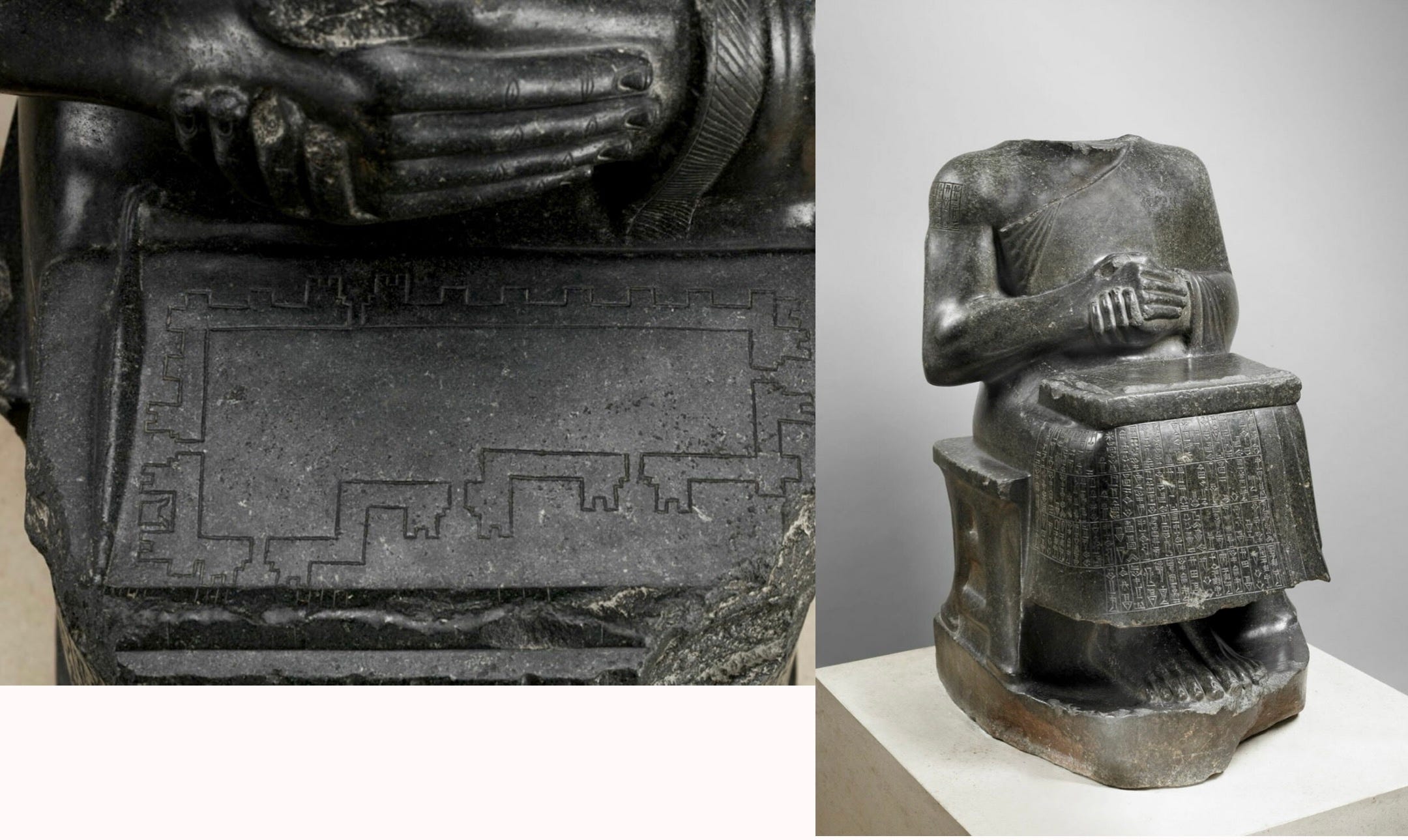
The oldest surviving architectural drawing might give us some clues. In the Louvre, we find a headless statue in dark stone of the Sumerian ruler Gudea, carved around 2110 BCE. He has a floor plan spread across his knees and a stylus in his hand. What does this gesture, this act of delimiting space, accomplish? It translates thought into form. Conceived for construction, architecture is at once earthy and engineered. It relates ideas and materials, imagined space and inhabited space, people to one another and to nature. The plan on Gudea’s knees announces, four millennia in advance, that architecture is, at its core, a way of thinking the future together: a way of constructing environments in synergy with nature and assembling worlds we have not yet entered.
The Romans gave us the first theory
The Romans were the first to theorise architecture, and their formulation has proved almost embarrassingly durable. Writing in the first century BCE for the Emperor Augustus, Vitruvius proposed his famous triad — firmitas, utilitas, venustas (solidity, utility, beauty).
Fifteen centuries later, Leon Battista Alberti, the Renaissance figure who effectively established architecture as an autonomous intellectual discipline in the Western tradition, was still wrestling with the same three terms. He translated and extended Vitruvius while writing his own magnum opus, De Re Aedificatoria. The great French urbanist Françoise Choay described that treatise as a meditation on the meaning underlying what she called “the transformative deployment of human beings in the natural world.” Architecture, on this reading, is the primary act by which humanity negotiates its presence on earth, the first and most continuous form of that negotiation.
Definitions proliferated as modernism, and then postmodernism, pushed the discipline to interrogate its pre-existing assumptions: not just how buildings were made, but what they meant, who they were for, and whether history was a resource, a burden, or something else entirely. Le Corbusier, who was constitutionally incapable of understatement, declared architecture to be “the masterly, correct, and magnificent play of masses assembled in light,” emphasising how light and shade reveal form to the eye. For Louis Kahn, architecture begins, as he put it, with the making of a room, returning the question to the human scale. Mies van der Rohe compressed an entire worldview into three words: less is more. Rem Koolhaas, unwilling to be cornered, called it “a way of thinking about the world,” which is either a profound observation or an elegant evasion, and possibly both. Each definition was, implicitly, a critique: an architect’s way of measuring the distance between what architecture had been and what, in their hands, it might yet become.
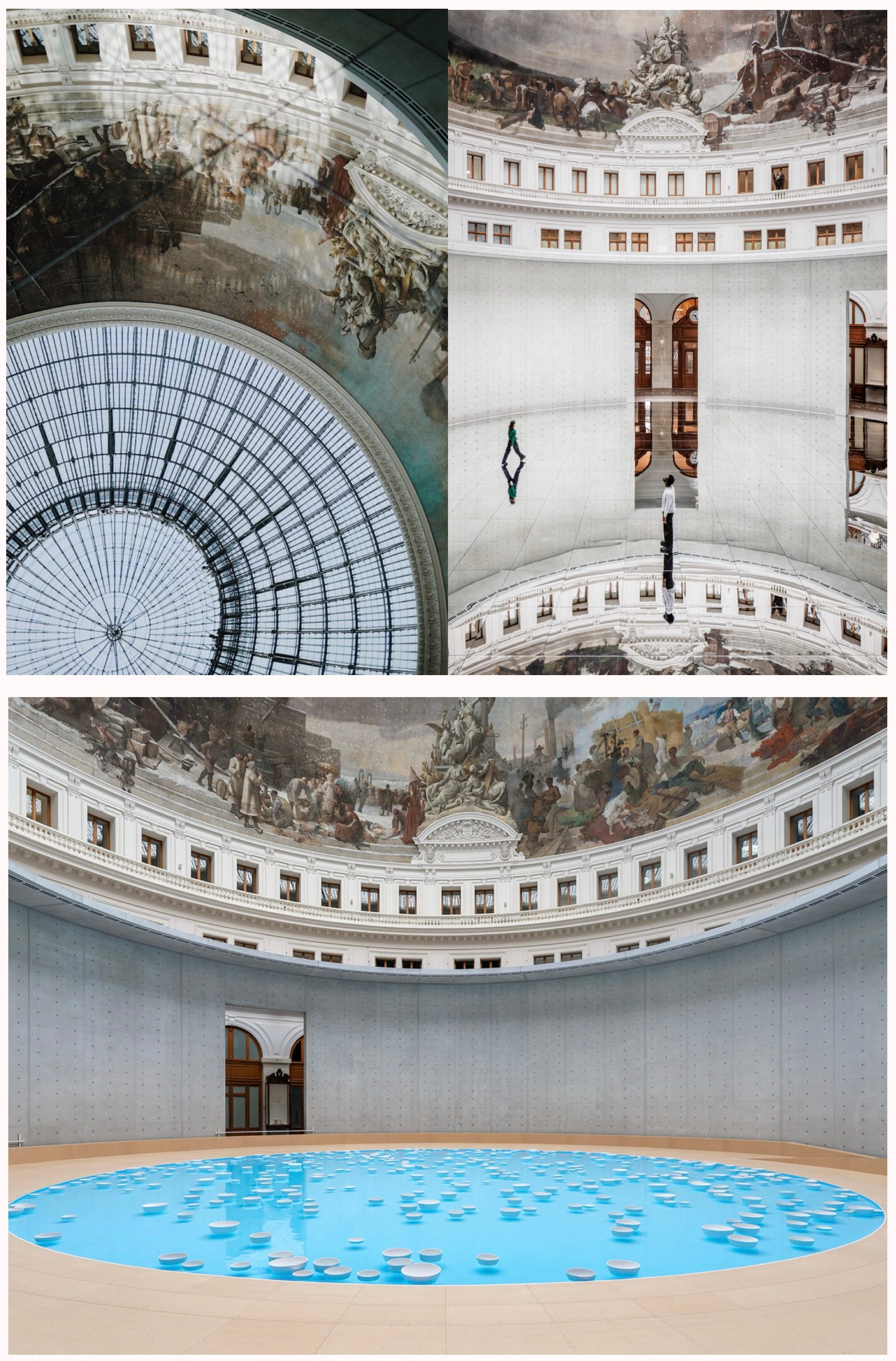
What I was after, I think, was less a definition than an account of the interaction among art, architecture, and the people who move through them. At the Bourse, this interplay is magnificently composed; the space alters with each new work on display and with each new way of seeing it. Each time one enters, the building is at once familiar and fresh. I still remember the delight of seeing the Korean artist Kimsooja turn the rotunda floor into a mirror-lake and pull the sky down to earth. Her interactive piece To Breathe – Constellation cast the building’s glass dome into a mirroring abyss, distorting and fragmenting, multiplying and unsettling its architecture. More playful, or perhaps more contemplative, Céleste Boursier-Mougenot’s clinamen reorganised the space by installing a wide basin of water in which porcelain bowls floated across a reflected sky. As a light current nudged them into one another, they produced soft, melodious vibrations that filled the space.
What is striking is that the word space itself entered architectural vocabulary only in the late nineteenth century. The Austrian architect Adolf Loos announced, with characteristic bluntness, that he did not conceive of plans or façades or sections — he conceived of spaces. He shifted the entire conversation from the two-dimensional to the three-dimensional, from drawn representation to lived experience. Space is what we move through, and what moves through us. It acts on us as we act on it.
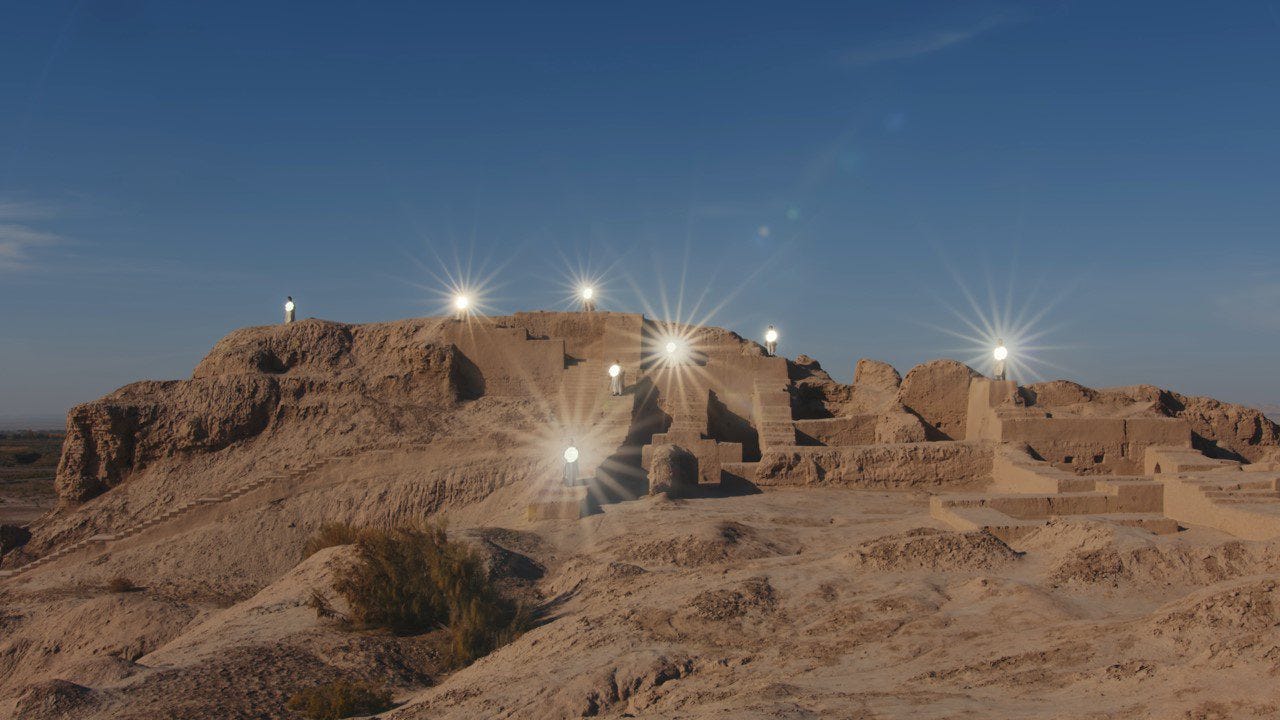
I was moving up and down the circular walkway at the top of the concrete structure, observing, ever more closely, the nineteenth-century murals of the cupola. But the experience of the building does not end above. It unfolds downwards, into the underground amphitheatre, where light gives way to projection. There, I recently watched Saodat Ismailova’s Melted into the Sun (2024), which explores fractures in post-Soviet Central Asia, from medieval Bukhara to Soviet solar furnaces, through the story of the eighth-century agitator Al-Muqanna. She draws on the grey areas of history and on repressed ancestral knowledge to think through the visible and invisible worlds embedded in landscapes, ancient architecture, ruins, and other zones of collective memory.
In the adjacent gallery, Philippe Parreno’s La Quinta del Sordo (2021) is still on view. Parreno returned to the house in which Goya, deafened and ageing, painted directly onto the walls the hallucinatory works that would come to be known as the Black Paintings. The piece proceeds from a conviction Parreno shares with Merleau-Ponty: that the visible is always lined with the invisible, that what we see is informed by what we do not. Parreno’s piece reminds us that a painting can belong to a wall. After all, the wall was the first canvas and remains a reliable support for the display of art. At the Bourse, art is moved, rotated, replaced, and projected.
Architecture, more than any other art, is never quite finished. A building continues to evolve long after the architect has gone, and its completion perhaps occurs only when it is demolished. The Bourse de Commerce is almost unrecognisable from its origins, and yet it remains continuous with them. It has been, in the most literal sense, the same building all along. Its history confirms as much. In the eighteenth century, Nicolas Le Camus de Mézières conceived the edifice in response to an urgent civic need: the storage of grain in the very heart of Paris.
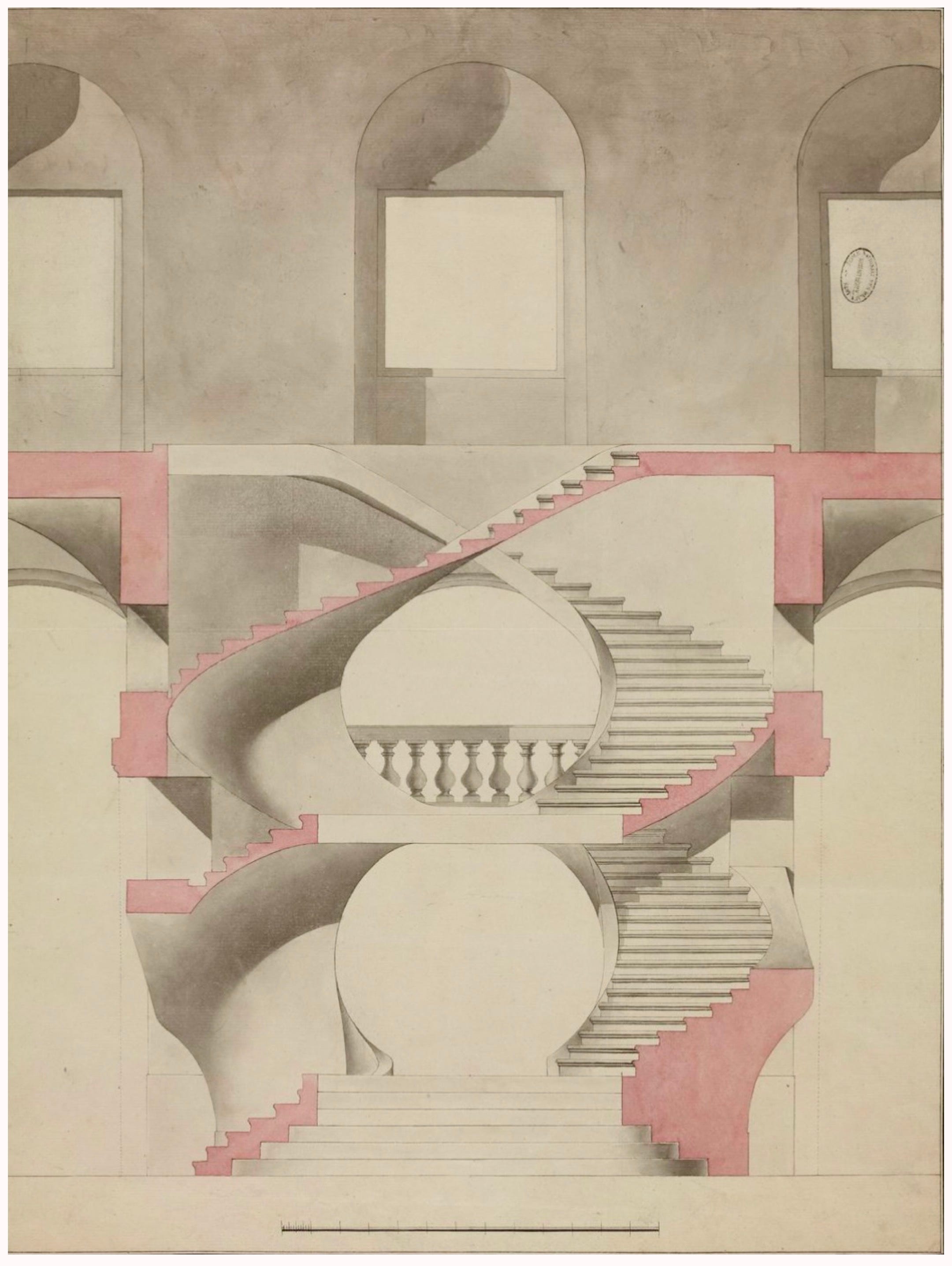
Designed with an eye turned towards antiquity, the Halle au Blé was a circular grain depot, topped first by a wooden dome, which Victor Hugo memorably dismissed as resembling an oversized English jockey’s cap.
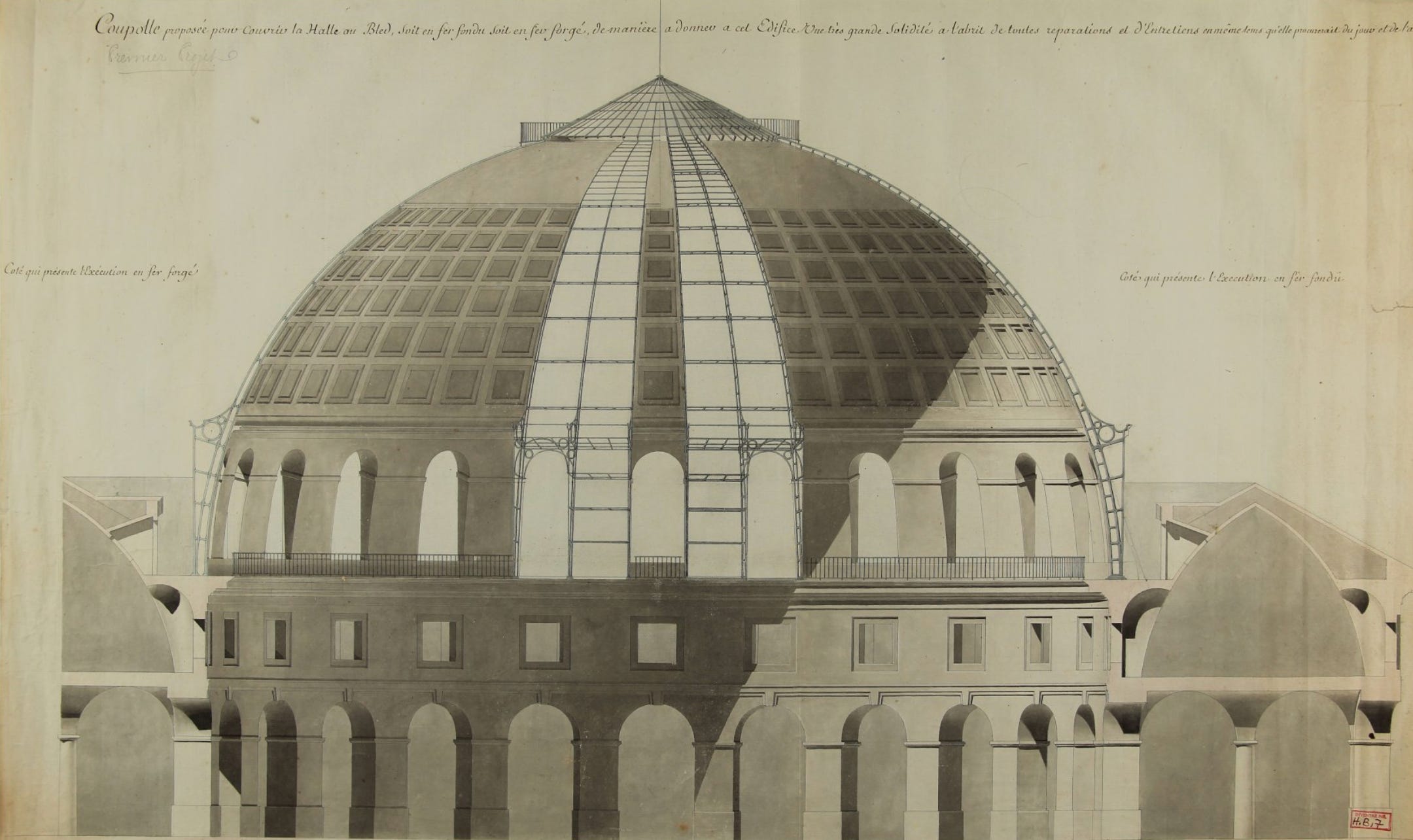
After fire destroyed the wooden dome in 1802, an iron-ribbed structure was raised in its place between 1809 and 1811, originally covered in copper and subsequently glazed in 1838. The building’s circular plan, with its central oculus, drew on the Roman Pantheon. The architect Henri Blondel converted the building into the Bourse de Commerce just in time for the 1889 Universal Exposition, its façades and interiors reworked for a new mercantile life. For decades, commodities traders sold sugar, coffee, and cocoa beneath the dome, enriching France’s colonial fortunes. More than a hundred years later, that world is not entirely gone. Its traces can still be read in the painted frieze that loops above, an imagined geography of empire. Now, the contemporary works shown in this room engage with the building’s history as much as with its present, and that dialogue carries aesthetic and political meanings, subtle or otherwise.
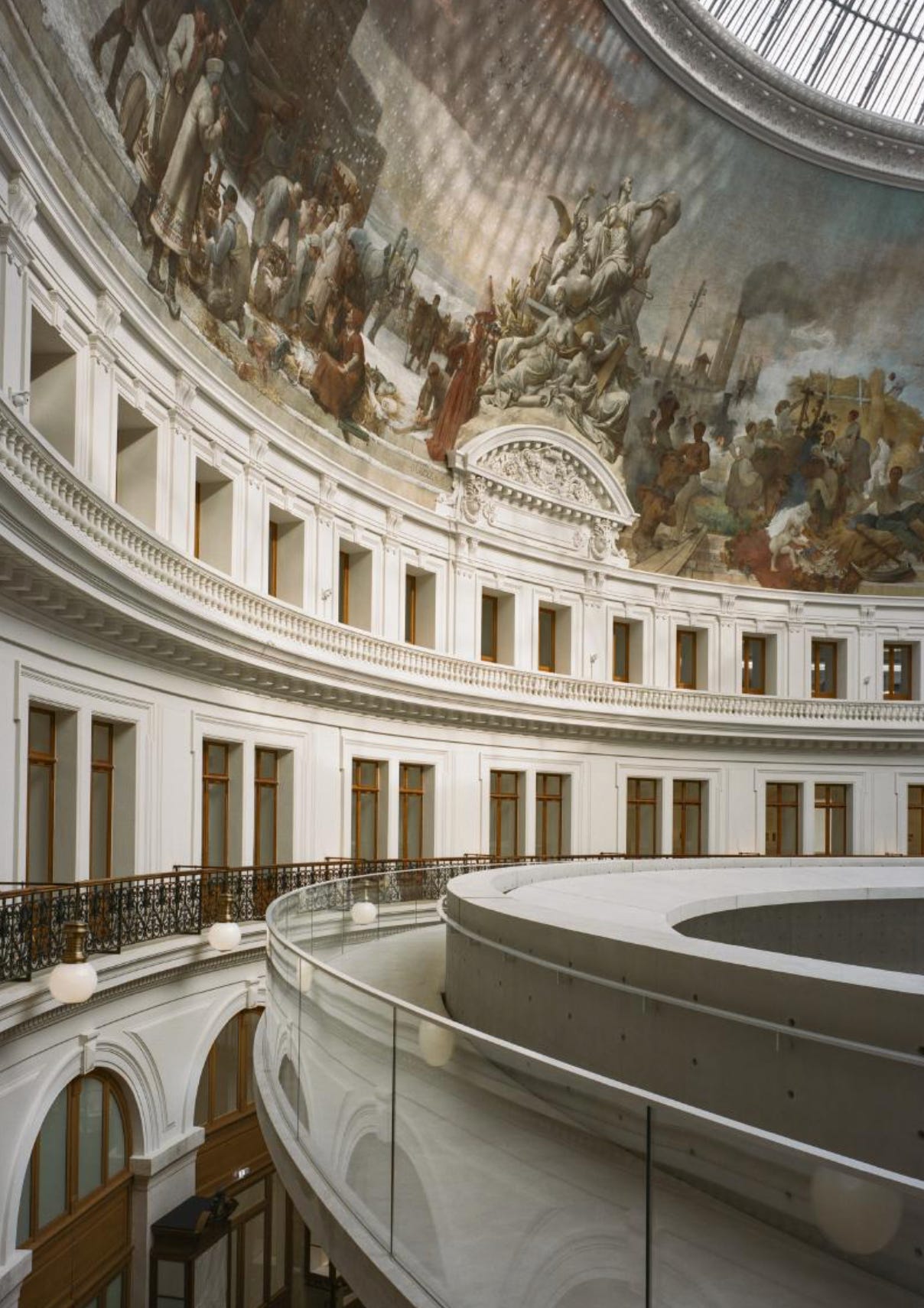
For three years, Tadao Ando — working alongside NeM Architectes and Pierre-Antoine Gatier, chief architect for historical monuments — laboured to rejuvenate the building once again. The brief was simple: to preserve the city’s memory inscribed in these walls while inserting into them an altogether different order. The structure’s several incarnations, all of which remain visible, seem to converse across time. Just outside, the so-called Medici Column, commissioned by Catherine de’ Medici, still stands, erected in the sixteenth century so that the queen’s astrologer, Cosimo Ruggieri, could read the stars on her behalf. Inside, Ando’s spare concrete walls turn the edifice into a vibrant stage for contemporary art.
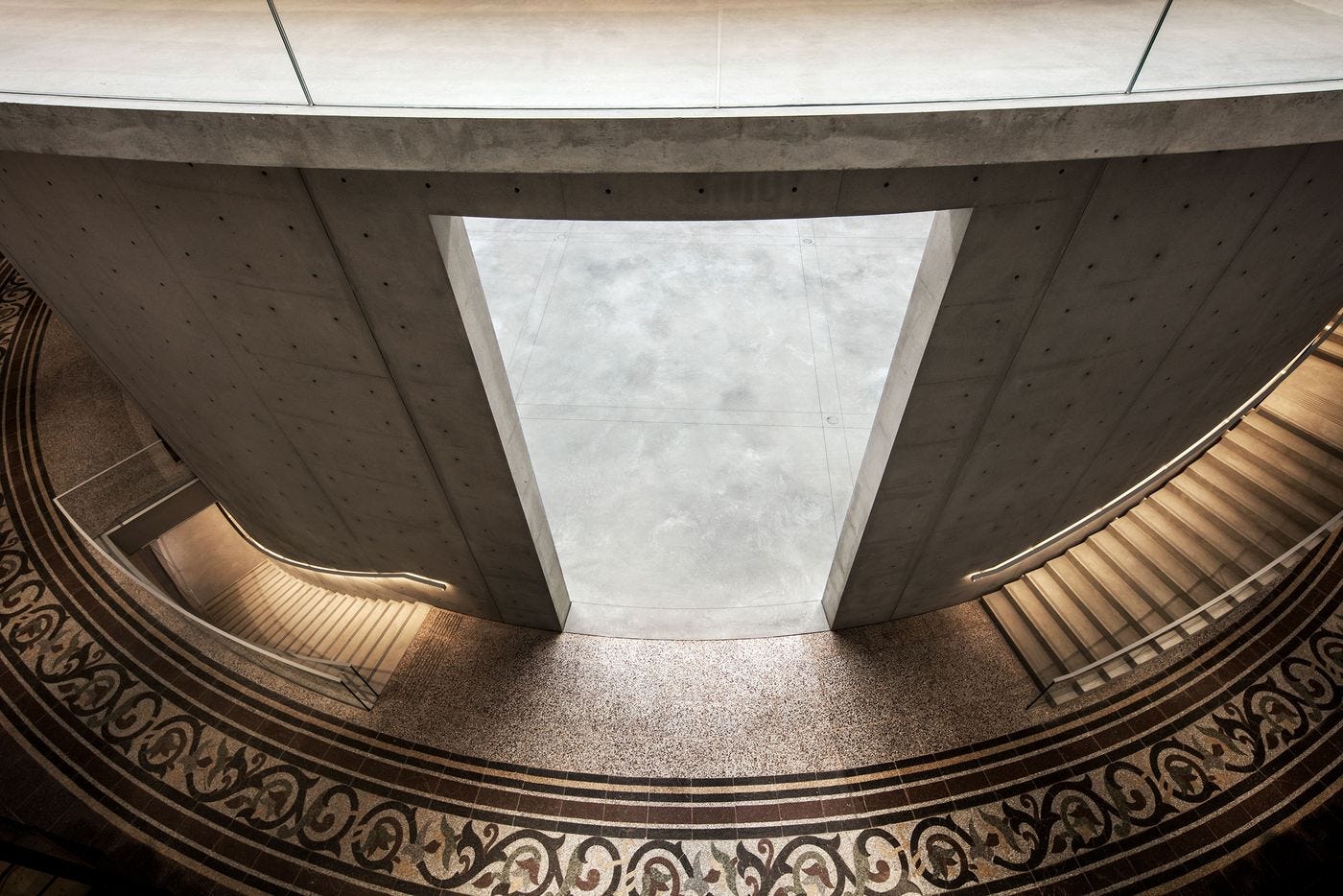
When you step into the exhibition space, you find no threshold to cross. The ticket counter has been relocated outside the building. The galleries circle the central rotunda; most are punctuated by windows on both the inner and outer walls, letting in soft, natural light. It is a space organised less by separation than by continuity, intended to blur the boundaries between inside and outside.
In Japanese, the space between two things has its own name. Ma is the interval, the charged emptiness between two presences, that conditions their meaning. Much of Japanese aesthetic life has been organised around it: the engawa that mediates between house and garden, the translucent paper screen, the elongated roof structure that gathers shadow before the rooms begin. Ando’s long-standing preoccupation has been the interval between inside and outside, and at the Bourse, ma is what the light does: it inflects every surface it touches.
Ando, however, shared an ambition older than himself. Henri Focillon, writing in 1930, phrased it with aphoristic elegance:
“Architecture is the creator of unpredictable environments. It satisfies needs, it propagates others, it invents a world.”
Architecture, then, transforms the real. It passes from necessity into the invention of worlds.
Knowingly or not, we all participate in this creation of worlds. Consider how often each of us has arranged or rearranged a room. At some point in our lives, we have moved furniture, taken down a partition, repainted a wall, or enlarged a window to let in more light. Behind every small decision lies a long sequence of others: ours, the landlord’s, the developer’s, the city’s, the architect’s, and the masons’ — decisions laid into the foundation a hundred years before any of us were born.
Thinking about architecture calls to mind the poet Paul Valéry, who, in his dialogue Eupalinos, compared it to music. Both arts, he wrote, do not represent the world, but envelop you within one of their own making. You are inside the work. You cannot step back from it. This is what makes architecture so singular among the arts, and so easy to take for granted or overlook: its inescapability. You are always already within it. Valéry hoped an architect might one day “petrify and fix in the durable order of his materials the celestial clarity” of music: a building that would rise as a kind of symphony in stone.
What is architecture, then? If architecture resists definition, it is because it is not an object held before us, but a condition we are held within. It is everything we have ever been: our bodies, our histories, our weather, our language, the world we inhabit. To attend to it is to hear space breathing, and to recognise, in its visual silence, the long form of our being.
As always, thank you for reading—
A.
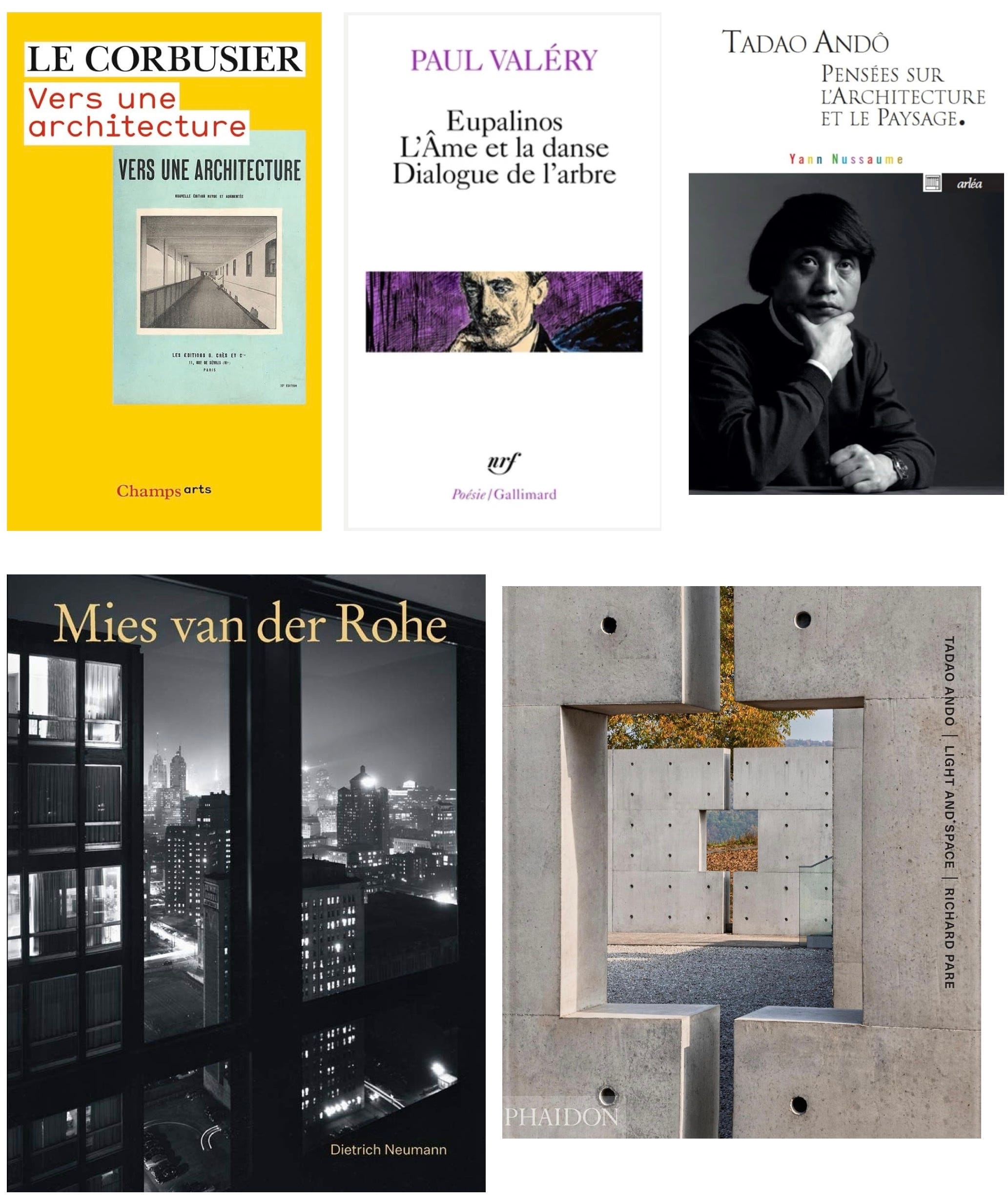
A few books I have enjoyed recently:
I used to be an architect ... when I realised I wasn't going to be the next Le Corbusier ... I quit and joined the merchant marine ... 🦋