

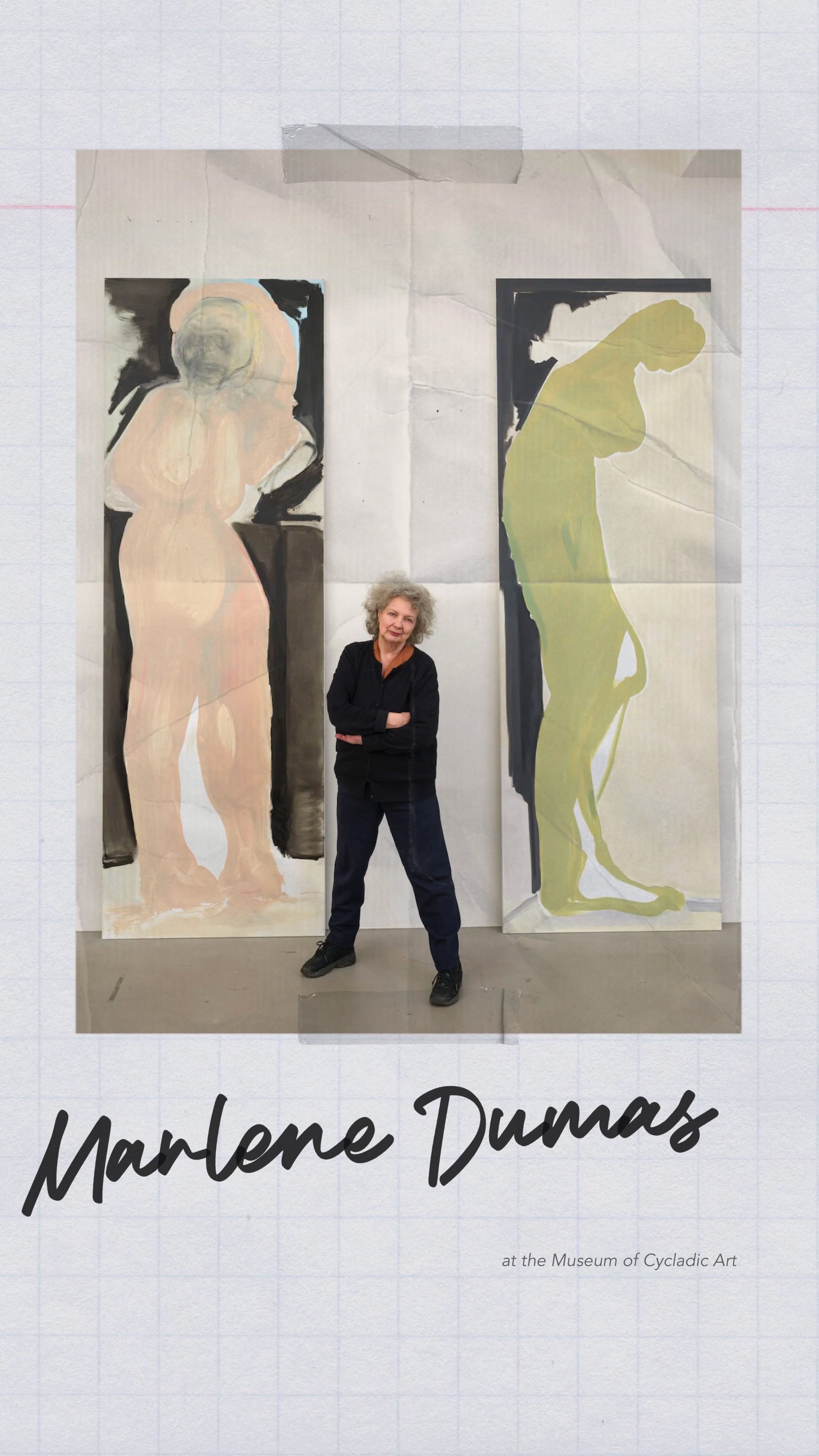
Bodies are stories. And every story, as it moves through time, finds a body to carry it. In Ancient Greece, a human life unfolded as a sequence of ritual thresholds—birth, initiation, marriage, the passage into old age, and finally death, imagined as the soul’s descent into the underworld. Each transition signified metamorphosis: the surrender of innocence, the acquisition of maturity, the flowering of youth, and the inevitable waning of the body with age. These are familiar stories. On a second glance, however, bodies are inescapably gendered and aged, and their stories are shaped not only by the social relationships in which they exist but also by how politics regulate them, for the body is always political.
When Marlene Dumas opens the conversation, at the Museum of Cycladic Art in Athens, between her paintings and figurines from the museum’s collection, she tells the story of the human body: “from being born, being young, being attractive and seductive, being betrayed and attacked, to being old and trying not to die.”
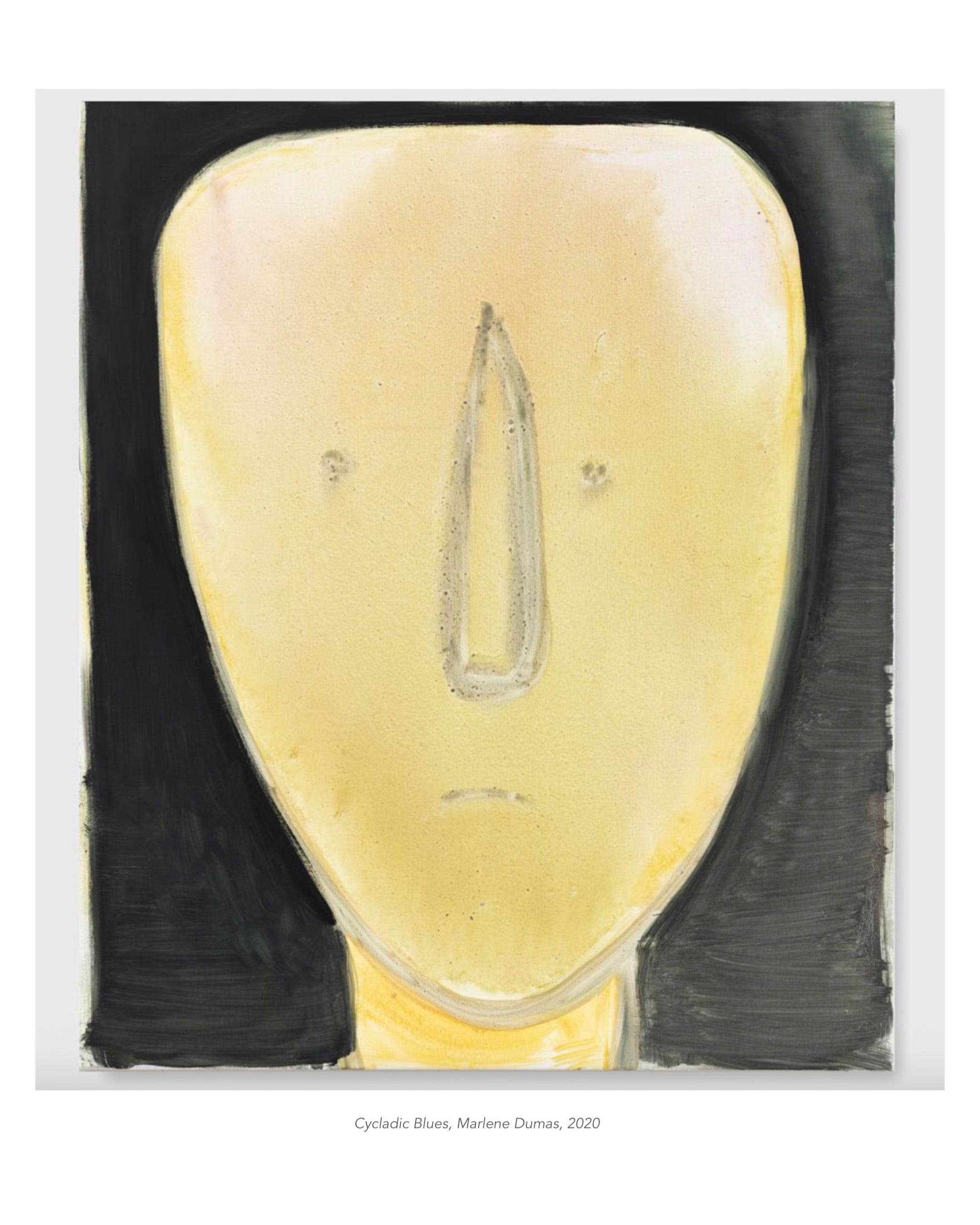
The exhibition’s title, Cycladic Blues, is also the name of a painting from 2020, depicting an elongated, shield-shaped head, with a rounded chin, a long and narrow nose, two small circular eyes and a single, slightly arched line suggesting a mouth, set perhaps in sorrow. The palette is black, grey and yellow, touched with dramatic whitish tones. For this show, together with curator Douglas Fogle, Dumas selected artefacts ranging from the Cycladic Bronze Age to sculptures from the Classical period. These figures, carved chiefly from marble, captivate through the clarity of their contours, minimalist design and the radical abstraction of the human form.
Inevitably, our modern gaze is refracted through the lens of twentieth-century art, compelling us to consider these works alongside those of Modigliani, Constantin Brancusi or Jean Arp. Most examples from the Cyclades represent nude female forms, their arms folded across the abdomen, their bodies etched with fine incised lines that mark either the pubic region or the conjoined legs, with knees slightly bent. The figurines—some of them distinguished by their shield or lyre-shaped heads and polished limbs, others fragmented—have been unearthed largely in tombs, suggesting perhaps that they once carried weight in the funerary rites.
In Cycladic Blues (2020) painting, Dumas’s use of luminous washes of diffuse ochre transparency, mingled with a dense, black-grey saturated background, carries a striking force. There is a certain power that lies in the plural form of the word “blues”, as it can signify wavelengths, emotions or even a musical style that turns feeling into form. The blues, therefore, becomes for Dumas a practice rather than a state: an act of reclaiming the possibility of emotion from a world that tends to exploit it or flatten it. For there are many blues and sorrows that shape a life.
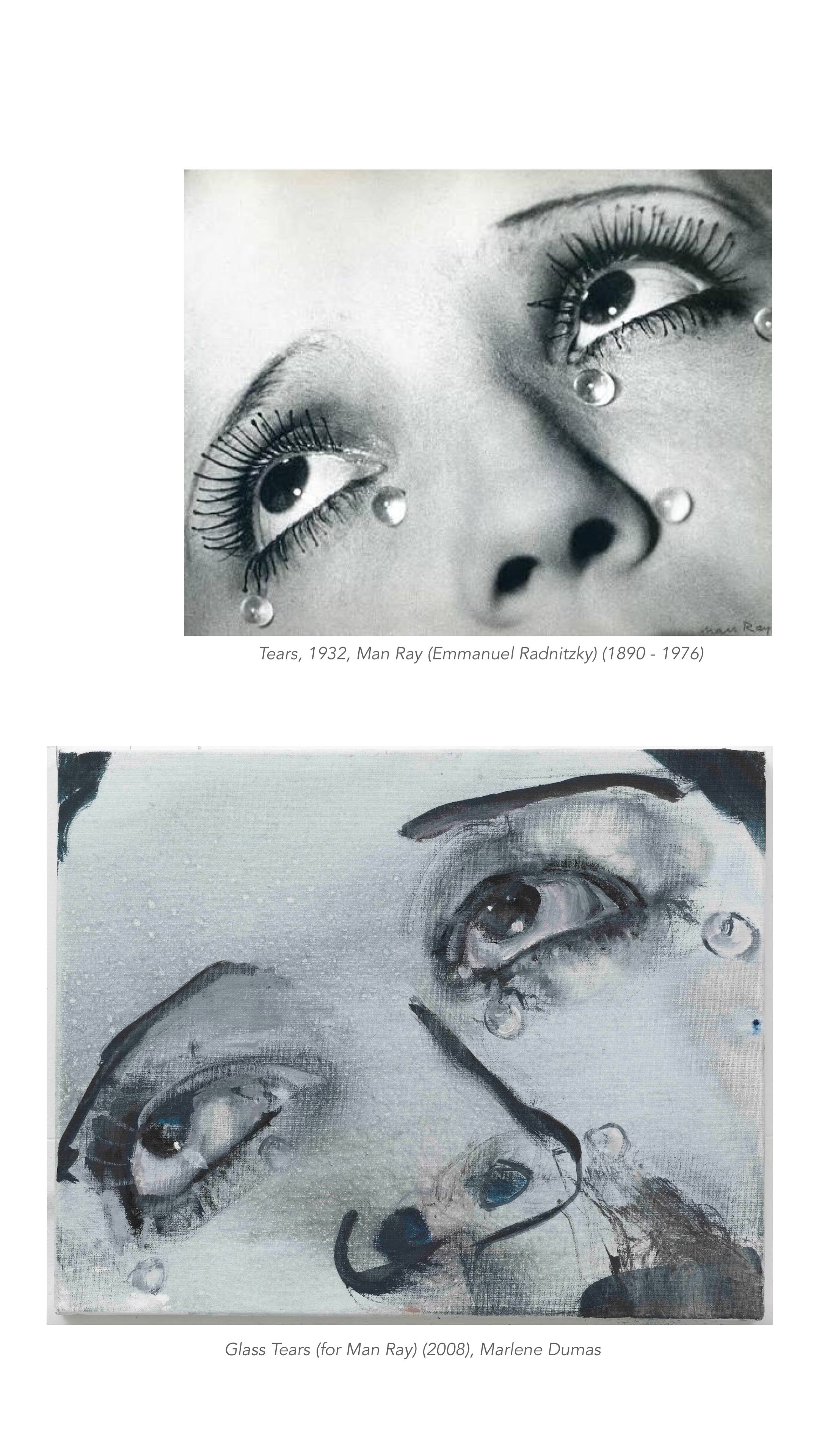
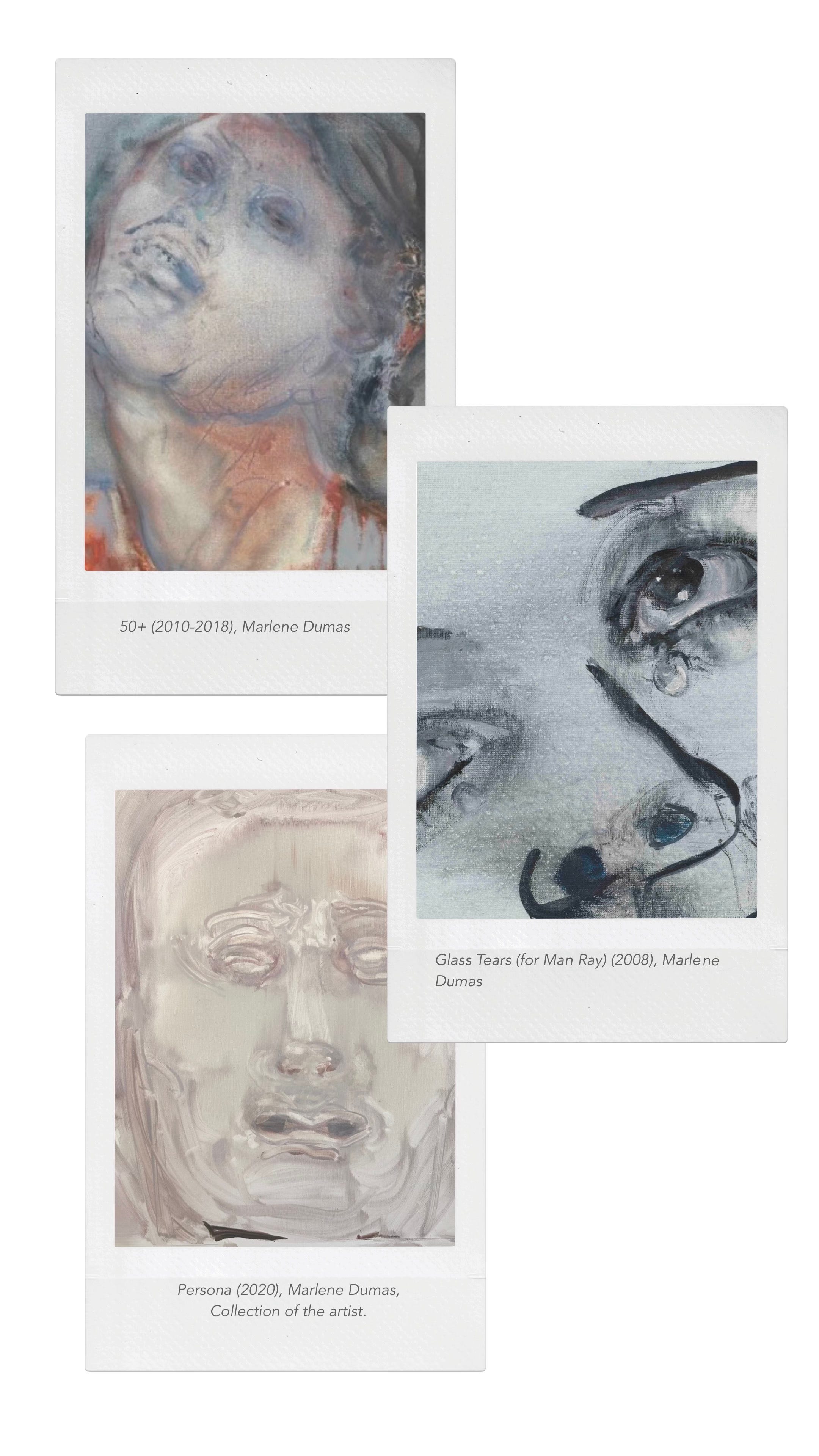
In one of her paintings, Glass Tears (for Man Ray) (2008), Dumas draws from Man Ray’s 1930s photograph Tears. His surrealist image of a French model resembles a film still: her mascara-coated lashes gaze upwards, while small glass beads appear as tears on her cheeks. It is an arresting image, prompting the viewer to wonder where she is looking and what is the source of her sorrow. It constitutes an aestheticisation of female suffering—a transposition of emotional distress. Dumas saw the photograph in a publication that described the image as a prototype for the cultural representation of crying. Though the reference to Man Ray remains explicit, Dumas uses it as a point of departure by transforming it into a painting. By its very nature, the painterly gesture constitutes a moral act: it begins from nothing, generating a surface animated by the artist’s physical movements and deliberate choices. The scattered droplets of water across the canvas underscore the tension between control and accident inscribed in the work’s texture.
A similar intention is visible in Persona (2020), in which she renders through distortion and abstraction a human face-form that cannot be clearly individuated. There is sorrow in this indeterminacy. Persona, Dumas explains, is rooted in the Latin word for “mask”—a practice by which ancient actors assumed a role of “speaking through.” Dumas paints in a way that resists descriptive function: like Gerhard Richter, she employs the blurring techniques, and she uses oil on the canvas as if it were watercolour. The surface reveals and conceals, while holding the traces of its maker. In this painting, she draws from a photograph of one of Auguste Rodin’s mask-like plaster casts created for The Gates of Hell (1880-1917). Rodin, Dumas reminds us, drew from the Parthenon marbles, a monument he regarded as the supreme achievement of sculpture.
Dumas too engages with Greek sculptures, but she does so by staying true to her creative process, painting from photographs of sculptures. In 50+ (2010-2018), she draws from a postcard of a Roman imitation of a Hellenistic sculpture. The image shows an old woman in a reclining posture, a wine jug in hand, perhaps paying tribute to Dionysus. Dumas preserves the woman’s posture, with her head tipped back, but renders it with deeper poignancy, modulating the face into an indeterminate register, poised between agony and ecstasy.
In her own words, Marlene Dumas’s use of “second-hand images and firsthand experiences”, situates her practice in a register that feels both timeless and deeply human. The image and the lived moment unfold on different temporal planes, yet across generations we encounter the same repertoire of individual and collective emotions: fear, sorrow, desire, love. This echoes Gilles Deleuze’s insight: “the image is not in the present. […] The image itself is a set of relations of time from which the present only derives, either as a common multiple or as the smallest divisor. Relations of time are never perceived in ordinary perception, but they are in the image, as soon as it is creative. It makes relations of time—irreducible to the present—perceptible, visible.” For Deleuze, a creative image makes visible those otherwise imperceptible folds of time, irreducible to the now. Sorrow, like guilt, is one of those human emotions that can be long-lived, lingering even for a lifetime, and may push some people to find their lives no longer worth living. Whether an individual or a collective emotion, sorrow permeates the body and its stories: the past endures within the present, even as the present gestures toward the future.
Dumas, like many of her generation, often articulates the moral dilemma of guilt as a profound uncertainty over which actions can be deemed just—and in whose eyes such justice is to be recognised. She knows this from firsthand experience, having grown up in a farming town outside Cape Town. The dark years of apartheid meant that relationships with the wider world were highly politicised. She understood how classical ideals had been manipulated and conscripted by fascists and colonial regimes for their own purposes. Leni Riefenstahl’s films, Triumph of the Will (1935) or Olympia (1938), invented and propagated a Nazi aesthetics in which the idealised body became a political tool for supremacy and a heinous political agenda.
Dumas moved to Holland in 1976, after earning a degree in fine arts from the University of Cape Town. Her ambivalent relationship with Greek culture took a turning point when she came to understand its role as a culture of resistance in African countries like South Africa. On Robben Island, for instance, political prisoners—including Nelson Mandela—staged Greek tragedies. These performances became acts of resistance, allowing prisoners to endure the political oppression. In Sophocles’ Antigone, they discovered an ethic of survival against the cruelty of tyrants. This aligns with Nietzsche’s idea in The Birth of Tragedy (1872), where he conceives of tragedy as an affirmation of life’s intensity in the face of meaninglessness and absurdity—a profound antidote to pessimism.
Nevertheless, art does not eliminate pessimism, but it has the potential to transform it into something more bearable. For the show in Athens, Dumas created two new monumental paintings, Old (2025) and Phantom Age (2025). They distil key aspects of her painterly vocabulary: the insistent materiality and movement of liquid, set against contour, embodiment, and tension. Her raw paint, along with distortion and elongation, gives poignancy to the painted sphere. The fluid and the indeterminate body forms suggest how political forces circumscribe the threshold between visibility and erasure. And this is what painting does: it intervenes in life, not necessarily to console the sorrow, but to redirect or alter a person’s course.
From the raw material of the politics of sorrow, Dumas transposes the affective immediacy provoked by the image of a sufferer into a sustained mode of reception—an engagement with the image that acknowledges the temporal density of the image, its impressions and its power to affect us. Through this, and the analogous use of imagination, Dumas reminds us that enduring is not only an individual act, but a collective engagement.
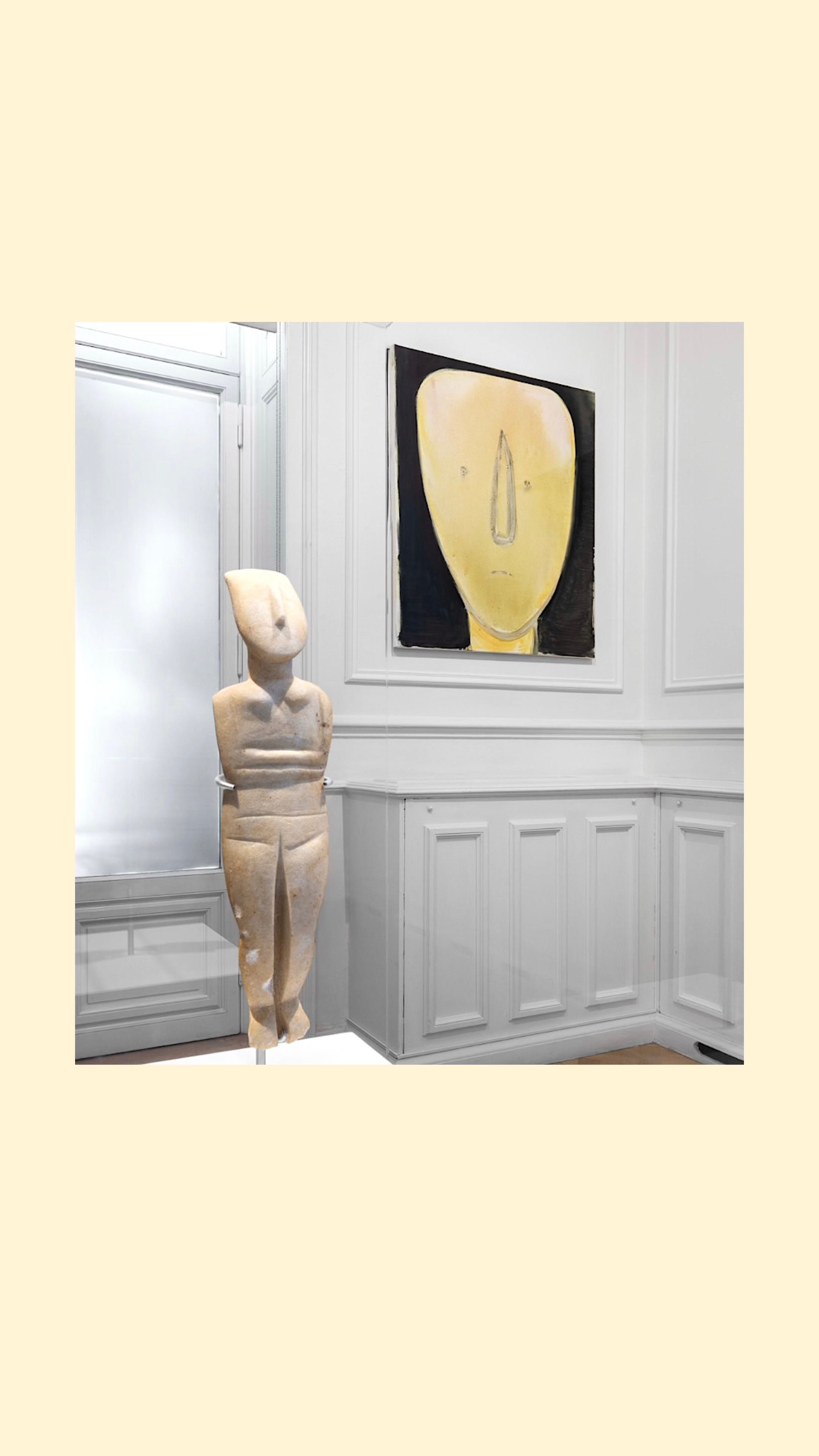
View of the Exhibition Photo. Paris Tavitian © Museum of Cycladic Art
Museum of Cycladic Art, Athens, Greece
June 5–November 2, 2025